
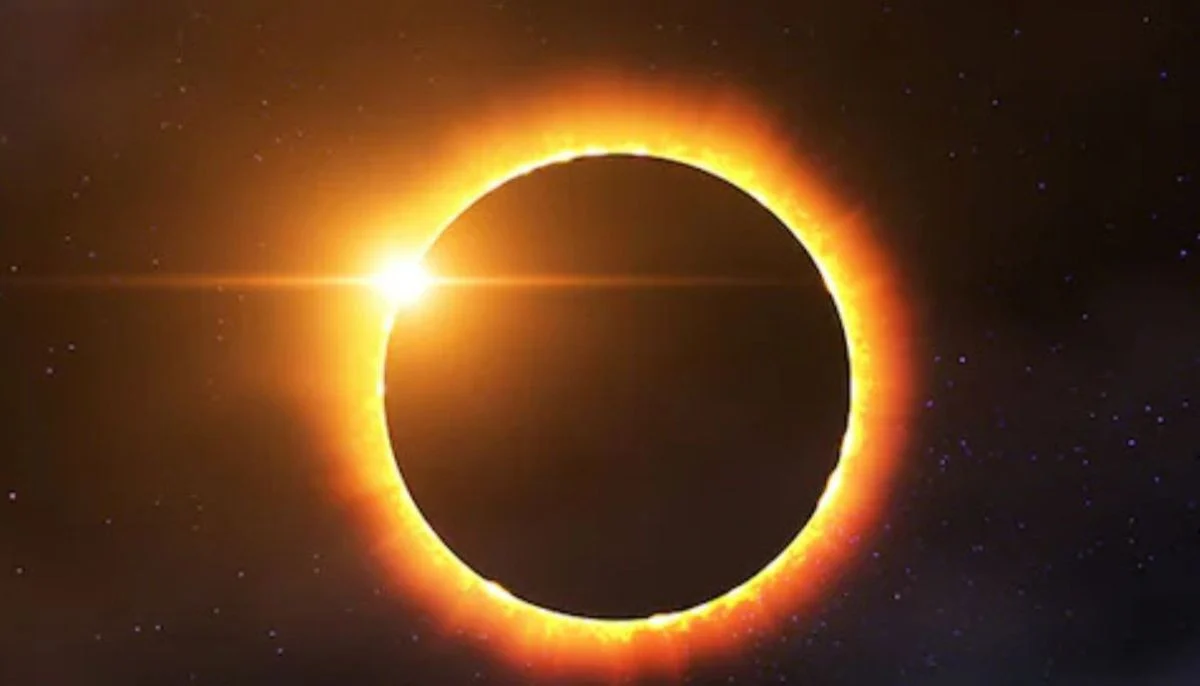
An annular solar eclipse is set to occur today, marking a rare celestial event when the Moon passes directly between the Earth and the Sun, revealing a bright, flaming border around the Moon’s silhouette.
The annular solar eclipse will commence its journey across a remote region of Antarctica where it will be visible to more penguins than people. The partial solar eclipse will be visible to observers in parts of southern Africa and the southern tip of South America. During an annular solar eclipse, the moon is comparatively distant and does not cover the sun’s disk as we see during a total solar eclipse. It produces a distinct ring of light in the sky, the “ring of fire.”
What to look for and how to watch safely
In order to witness the annular solar eclipse, one will notice the moon slowly moving across the sun while creating a partial eclipse. As the coverage increases to about 80%, shadows on the ground begin to sharpen and lose their fuzzy edges. There is a significant difference between partial and annular solar eclipses because there is no moment when the moon fully covers the sun’s bright face. It is never safe to look directly at a partial or annular eclipse without proper eye protection.
Where can you see the next solar eclipse?
The next solar eclipse will be a total solar eclipse on August 12, 2026. Visible across Greenland, western Iceland, and northern Spain, it will offer a maximum of 2 minutes and 18 seconds of totality. Remarkably, this event occurs just before the peak of the annual Perseid meteor shower.