
The American economy expanded at its fastest pace in two years in the third quarter, according to official figures.
Data released by the Commerce Department showed gross domestic product grew at an annualised rate of 4.3 per cent between July and September.
The reading significantly exceeded economists’ expectations.
Forecasts had pointed to growth of about 3.2 per cent, down from the 3.8 per cent recorded in the previous quarter.
The Bureau of Economic Analysis said the expansion “reflected increases in consumer spending, exports, and government spending that were partly offset by a decrease in investment”.
Household spending was the main driver of growth during the quarter.
Consumer expenditure accelerated to an annualised rate of 3.5 per cent, compared with 2.5 per cent in the previous three months.
This increase came despite signs of a cooling labour market, while public concern about rising prices has also persisted.

The American economy expanded at its fastest pace in two years in the third quarter
|
GETTY
Economists said higher spending on healthcare services accounted for a large share of the increase in consumer activity.
Exports rebounded strongly after falling earlier in the year as overseas sales rose by 7.4 per cent during the quarter.
Government spending also made a positive contribution to overall growth, although the headline figure was partially offset by a decline in investment.
Imports, which subtract from gross domestic product calculations, continued to fall.
The decline followed the introduction of tariffs on foreign goods by President Trump earlier this year.
Despite significant policy changes affecting trade and immigration, the underlying economy maintained solid momentum.

The release of the data was delayed because of a prolonged government shutdown
|
GETTY
The release of the data was delayed because of a prolonged government shutdown as federal operations were paralysed for more than six weeks, from October 1 to November 12.
During that period, civil servants across multiple departments were furloughed, with staff involved in compiling and processing economic statistics among those affected.
The delay has complicated efforts by the Federal Reserve to assess the more general economic conditions as other major reports had been held back as a result of the shutdown.
The delayed figures nonetheless provide policymakers and markets with important insight into economic trends.
The shutdown has clouded decision-making at a sensitive moment for monetary policy, with the Federal Reserve facing a complex set of choices on interest rates.
Earlier this month, the central bank implemented its third interest rate cut of the year.
Despite signs of growth, inflation remains above the Reserves target of two per cent a year, which has strengthened arguments among some officials for keeping borrowing costs higher for longer.
At the same time, emerging signs of labour market softening have raised concerns about rising unemployment.
Economic activity has remained resilient during a year marked by significant volatility.
In April, President Trump announced wide-ranging tariffs on several major trading partners.
Many of those measures have since been scaled back or removed.
The uncertainty surrounding trade policy has weighed on business and consumer confidence, with the economy contracting in the first quarter of 2025.
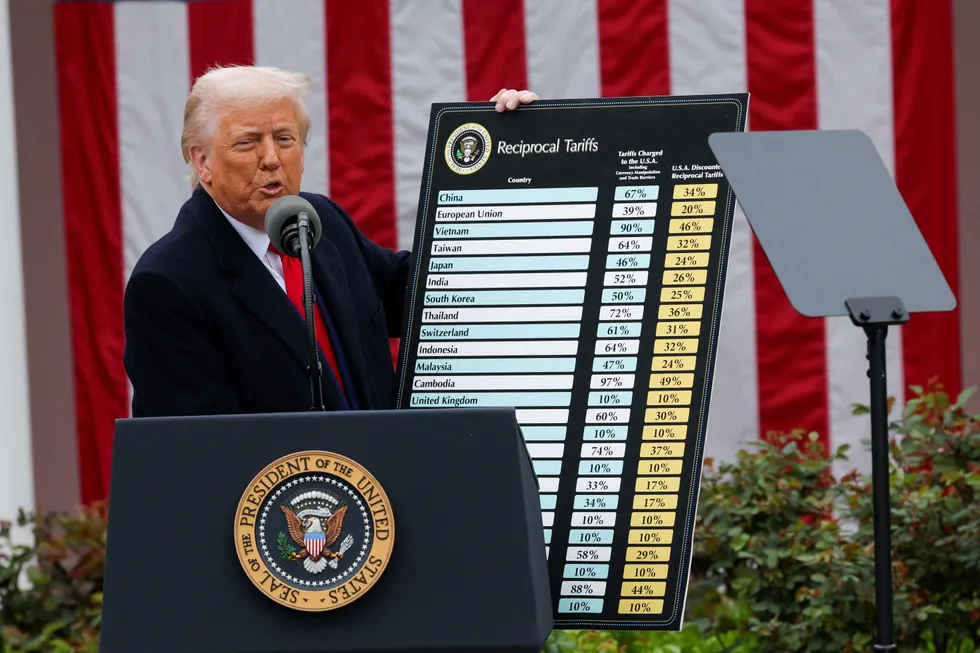
President Trump introduced sweeping tariffs on a huge amount of countries
|
ReutersThe downturn followed a surge in imports as firms sought to bring in goods ahead of potential tariffs, but growth recovered relatively quickly in subsequent months.
Economists said the rebound was supported by strong household spending, with investment linked to artificial intelligence also provided support.
Paul Ashworth, chief North America economist at Capital Economics, said: “The economy maintains considerable momentum.
“That said, the shutdown could trigger a slowdown in the fourth quarter to nearer two per cent annualised.”


