
Mind control weapons may sound like something from a dystopian science fiction film, but experts now say they are becoming a reality.
Scientists have issued an ominous warning over mind-altering ‘brain weapons’ that can target your perception, memory, and even behaviour.
In a newly published book, Dr Michael Crowley and Professor Malcolm Dando, of Bradford University, argue that recent scientific advances should be a ‘wake-up call’.
Professor Dando says: ‘The same knowledge that helps us treat neurological disorders could be used to disrupt cognition, induce compliance, or even in the future turn people into unwitting agents.’
Nations including the US, China, Russia, and the UK have been researching so-called central nervous system (CNS)-acting weapons since the 1950s.
Now, Dr Crowley and Professor Dando argue that modern neuroscience has become so advanced that truly terrifying mind weapons could be created.
Professor Dando says: ‘We are entering an era where the brain itself could become a battlefield.
‘The tools to manipulate the central nervous system – to sedate, confuse, or even coerce – are becoming more precise, more accessible, and more attractive to states.’

Scientists have issued an ominous warning that developments in neuroscience could see powerful ‘brain weapons’ become a reality (stock image)

Just like the fictional drug ‘Soma’ from the science-fiction classic ‘Brave New World’ (pictured), scientists warn that new chemicals could be used as a powerful form of mind control
Throughout the 1950s and 1960s, most of the world’s major powers ‘actively sought’ to develop their own mind-controlling weapons.
Their goal was to create devices that could incapacitate large numbers of people through unconsciousness, hallucination, disorientation, or sedation.
Most famously, the American military developed the compound ‘BZ’, which produces a powerful sense of delirium, hallucinations, and cognitive dysfunction.
The US manufactured approximately 60,000 kilograms of the potent drug and used it to create a 340-kilogram (750 lbs) cluster bomb.
Although the bomb was intended to be used in Vietnam, and BZ was tested intensively on US soldiers, there’s no evidence that the weapon was ever used.
Meanwhile, the Chinese military has developed a ‘narcosis-gun’ designed to shoot syringes of incapacitating chemicals.
However, Dr Crowley and Professor Dando point out, the only time that a CNS-targeting weapon has ever been used in combat was by Russian security forces during the 2002 Moscow theatre siege.
After armed Chechen militants took 900 civilians hostage, security forces used a fentanyl-derived ‘incapacitating chemical agent’ to disable the attackers.
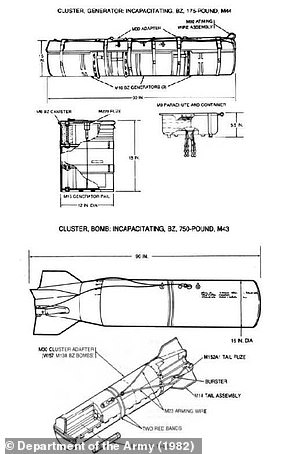
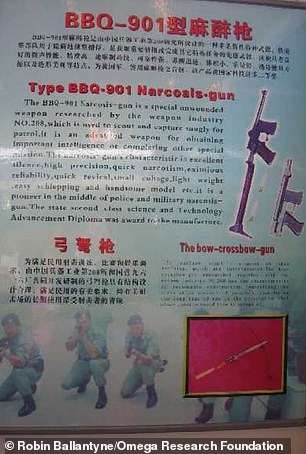
Since the 1950s, major world powers have been attempting to create chemical weapons that target the brain. These include the US military’s BZ bomb filled with hallucination-inducing gas (right) and the Chinese ‘Narcosis-gun’ (right)

The only time that so-called central nervous system (CNS)-targeting weapons have been used was by the Russian security services during the 2002 Moscow theatre siege (pictured). A gas containing fentanyl derivatives was used to knock out the gunmen inside
While the chemical weapon did break the siege, the gas killed 120 of the 900 hostages and an undetermined number more to face long-term health issues and premature death.
However, since then, the mind-warping potential of these weapons has extended far beyond simply knocking out attackers or triggering hallucinations.
The same scientific research that is helping to treat neurological disorders can also be used to build weapons which target specific brain functions.
‘That’s the dual-use dilemma we face,’ says Professor Dando.
For example, scientists are investigating parts of the brain’s ‘survival circuits’, which are the neural pathways that control fear, sleep, aggression, and decision making.
Understanding how these circuits work is critical for treating neurological conditions, but also opens the door to weaponising these regions of the brain.
In fact, Dr Crowley and Professor Dando are so concerned about this possibility that they are travelling to the Hague for a key meeting of states to argue the case for urgent action.
The issue, the researchers warn, is that CNS-targeting weapons currently sit within a ‘loophole’ in the rules governing the use of chemical weapons.
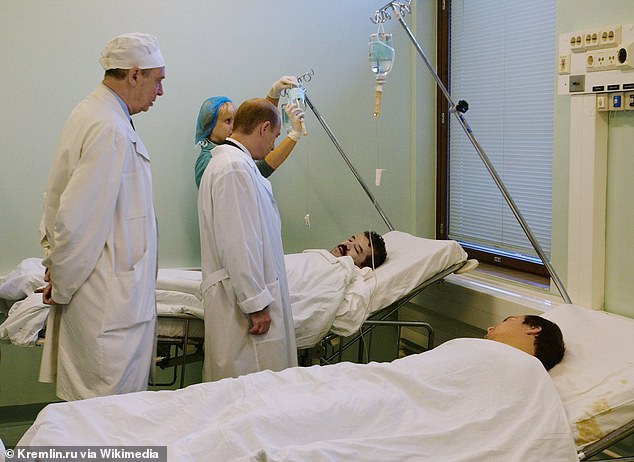
While the gas did break the siege, it also killed 120 of the 900 hostages in the theatre and left an unknown number with life-long illnesses. Pictured: Vladimir Putin visits survivors of the theatre siege
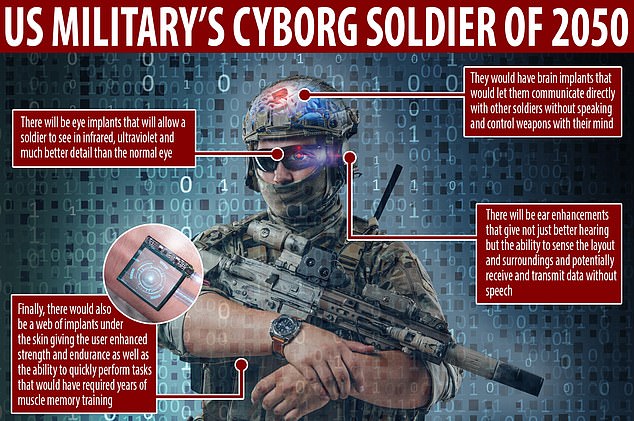
This comes amid growing concern that future armies could be made up of cyborgs with neurological enhancements allowing them to see, hear and fight better than current soldiers
The Chemical Weapons Convention prohibits the use of harmful chemicals in war, but there is a grey area allowing the use of some chemicals in certain circumstances, such as law enforcement.
That leaves a potential legal justification for the development and use of powerful mind-control weapons within the current scope of the law.
Professor Dando says: ‘There are dangerous regulatory gaps within and between these treaties. Unless they are closed, we fear certain States may be emboldened to exploit them in dedicated CNS and broader incapacitating agent weapons programmes.
‘We must act now to protect the integrity of science and the sanctity of the human mind.’