It would prove to be a defining pop culture moment, the catalyst for the video age and one of the most significant TV events of the decade.
It’s a grand statement, but MTV – with a little help from NASA – helped turn music in all its forms into a visual medium after launching as an innovative new channel on August 1, 1981.
Opening with a 90 second sequence of manipulated images taken from the 1969 moon landing, the American flag embedded into its pockmarked surface superimposed with the now legendary MTV logo, there was the suggestion that ambitious producers were already reaching for the stars.
And why not? If New York City was the place, then the universe and beyond was the destination as they realised the unexplored potential of visual entertainment in the video age.
Even the very first song aired by MTV, the appropriately named Video Killed The Radio Star by Australian band The Buggles, served as a thinly veiled manifesto for the burgeoning channel.
And for decades they did just that, capturing the zeitgeist as the ’80s faded into the ’90s and the cult of reality TV replaced music as its strongest output.

MTV has announced plans to shut down all music programming channels, notably MTV Music, MTV ’80s, MTV ’90s, Club MTV and MTV Live, across England and Ireland from December 31
But all good things come to an end, with MTV recently announcing plans to shut down all music programming channels, notably MTV Music, MTV ’80s, MTV ’90s, Club MTV and MTV Live, across England, Ireland from December 31.
The same channels will be taken off air in France, Germany, Austria, Poland, Hungary, Australia, and Brazil in the new year.
Flagship channel MTV HD ‘will still have a presence’ but bosses state that there will be no more original music content.
Instead, generic American shows will be aired alongside the usual rolling schedule of music videos.
A source confirmed: ‘Everyone at MTV is gutted. To say there has been a bloodbath of cuts would be an understatement.
‘Staff have been left in tears as some have been there for decades. Those that are left fear more doom and gloom could be around the corner.’
It’s the end of an era, but fear not! Daily Mail has gathered some of the most memorable MTV moments from its extraordinary 44-year run.
DAVID BOWIE’S DIVERSITY ROW (1983)
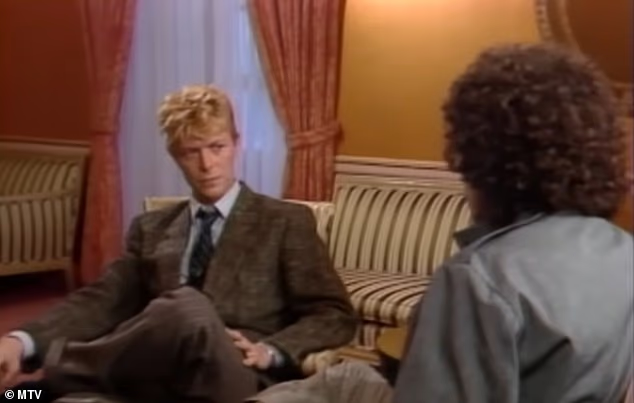
David Bowie openly criticised MTV for failing to promote black artists during an interview with the music channel in 1983
The heady days of Ziggy Stardust and the Spiders From Mars were already a thing of the past when David Bowie sat down for a televised interview with MTV in 1983.
Bowie was back after a three year absence with eagerly anticipated new album Let’s Dance, but the pioneering singer clearly had other things on his mind during a sit-down chat with VJ Mark Goodman.
Indeed, instead of discussing his latest music, the British star used his platform to criticise MTV for underrepresenting black artists.
Referencing the apparent lack of diversity, an aggrieved Bowie told Goodman: ‘It occured to me, having watched MTV, that’s it’s a solid enterprise and its got a lot going for it.
‘I’m just floored by the fact that there’s so few black artists on it… the only few black artists that one does see are on at about 2:30 in the morning, to around 6:00. Very few are featured predominantly during the day.’
He added: ‘There seem to be a lot of black artists making really good videos that aren’t being featured on MTV.’
Bowie went on to describe the issue as ‘rampant’ throughout US media, with his comments prompting a wider debate and putting MTV under pressure to confront the issue of diversity and inclusivity in its schedule.
They also led to a broader awareness of diversity within mainstream media, notably the music industry, and the singer’s prescient comments are still referenced to this day, some nine years after his untimely death.
THE SPICE GIRLS AND A TRIBUTE TO DIANA (1997)
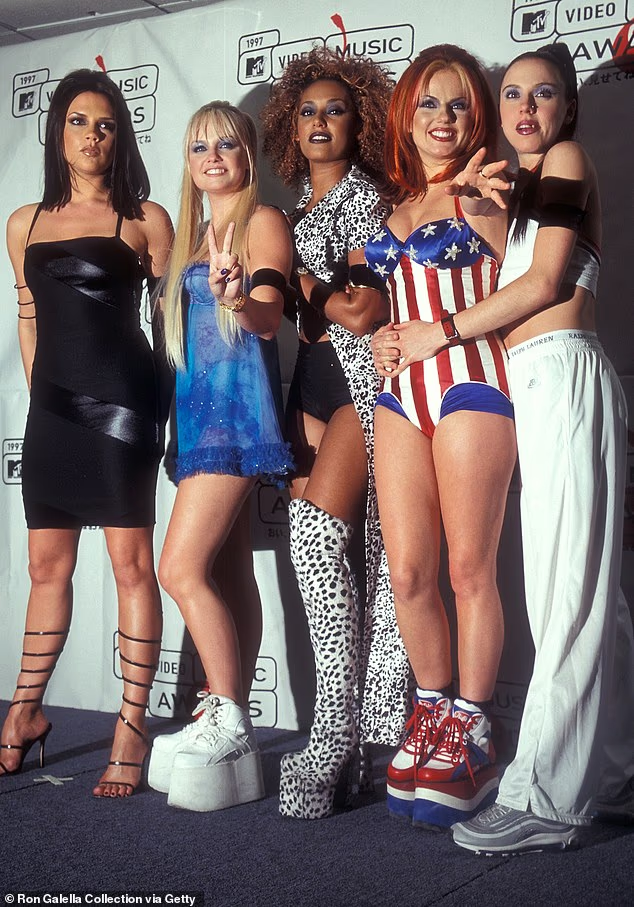
The Spice Girls wore black armbands while appearing at the MTV Video Music Awards in 1997 -a poignant tribute to Diana, Princess of Wales, who died in a car accident just days earlier
The year was 1996 and five unknown girls from England were afforded the sort of reception not seen since the advent of Beatlemania after arriving in the United States to promote their debut single, Wannabe.
But it would get a whole lot better for the Spice Girls after the era-defining girl-group claiming their first US accolade at the televised MTV VMA Awards the following year.
With Wannabe named Best Dance Video at the event on September 4, the girls dedicated their award to Diana, Princess Of Wales, who died just days earlier following a car accident in Paris.
With millions watching at home, Mel B, Geri Halliwell, Emma Bunton, Victoria Adams and Mel C took to the stage at New York’s Radio City Music Hall wearing black armbands in a poignant tribute to the late Princess.
The event, preceded by Diana’s tragic death, would reinforce their Girl Power manifesto and further solidify their status as one of the biggest pop groups on the planet.
INTRODUCING… THE OSBOURNES (2002)
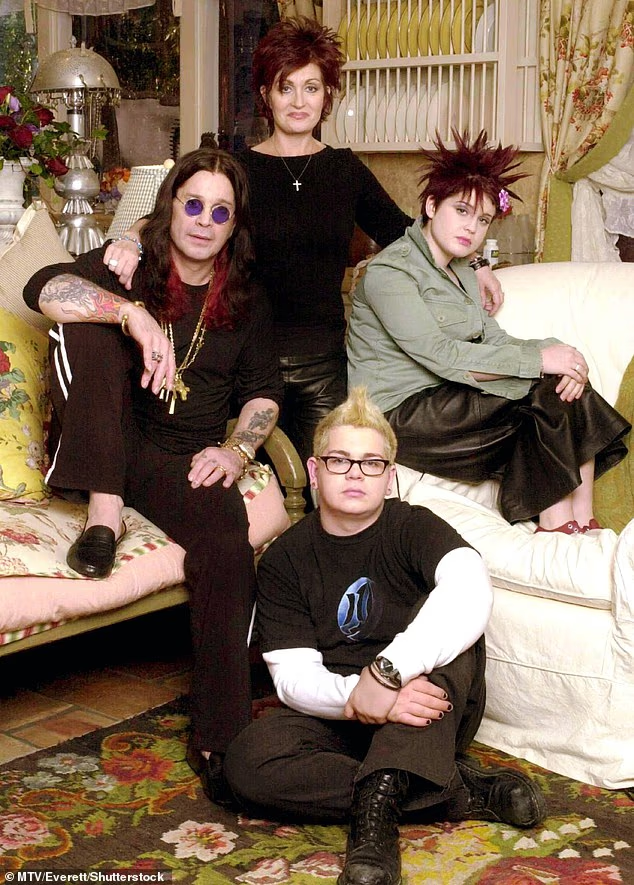
Across three years, four seasons and 52 chaotic episodes, The Osbournes created countless viral moments following its launch in 2002

With Ozzy Osbourne and his wife Sharon granting cameras unlimited access to their Beverly Hills home, viewers were given a rare insight into a never-ending series of domestic dramas
SHARON!!!!’
Across three years, four seasons and 52 chaotic episodes, The Osbournes created countless viral moments following its launch in 2002.
So where best to start than the very beginning? It was here, after all, that MTV transitioned from premium music channel to a revolutionary champion of reality television with a unique fly-on-the-wall format that has since been copied to the point of tedium.
With Black Sabbath rocker Ozzy Osbourne and his wife Sharon granting cameras unlimited access to their sprawling Beverly Hills home, viewers were given a rare insight into a seemingly never-ending series of domestic dramas.
It pulled back the veil on the legendary metal singer’s quirky and often explosive relationship with Sharon and their two rebellious teen children, Kelly and Jack.
And audiences lapped it up. From the fights and blazing rows between Kelly and her mother, to repeated feuds with their well-to-do neighbours.
It also pulled no punches when it came to language – almost every other word was a ‘f***’, ‘s***’ or ‘c***’.
Summing up the mayhem during the film’s premier, Osbourne told his family: ‘I love you more than life itself but you’re all f***ing mad.’
The show smashed records for MTV, becoming the broadcaster’s highest-rated programme ever – but Ozzy later admitted he was high on drugs for much of it.
HIT ME BABY… THE CONTROVERSIAL LAUNCH OF BRITNEY SPEARS (1998)

Wow: Britney Spears’ debut hit …Baby One More Time and its iconic video has become synonymous with the record-breaking artist – but the track was nearly recorded by two other legendary groups
After almost two decades of back-to-back music videos you would be forgiven for thinking you’d seen it all, and maybe you had – until September, 28, 1998.
If anything is going to divide an audience, it’s sexual objectification – and when the sexually objectified happens to be a 16-year old singer, dressed in a skimpy school uniform, criticism is never going to be far away.
And so it proved after Britney Spears burst onto the music scene with debut single … Baby One More Time and its notorious music video, filmed in the corridors of a real life school in California.
Video director Nigel Dick later insisted the concept had in fact come from Spears, who was unenthused by his original plan to attract younger fans by creating a ‘cartoon-like environment’ for her debut music video.
But the finished product, which opens with a bored looking Spears sitting in class and ends with her seated alongside a presumed love interest – played by her real life cousin, Chad – invited criticism for its perceived presentation of teenage girls as objects of sexual desire.
Regardless, the video would prove to be an instant pop culture moment following its launch on MTV and would help turn Spears into a global superstar.
GEORDIE SHORE STAR NATHAN HENRY COMES OUT AS GAY (2015)
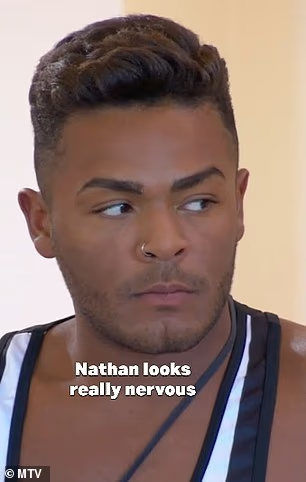
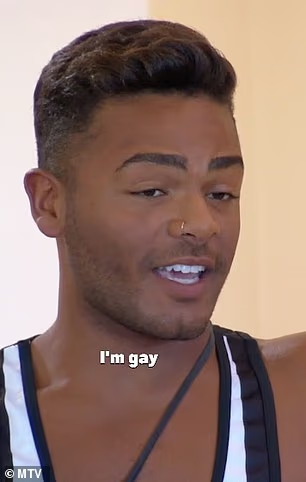
He was initially thought to be bisexual, but Nathan Henry’s true feelings emerged during the eleventh series of long-running British reality show Geordie Shore – and viewers were hooked
He was initially thought to be bisexual, but Nathan Henry’s true feelings emerged during the eleventh series of long-running British reality show Geordie Shore – and viewers were hooked.
With Greece providing a picturesque backdrop, Henry chose a summer break as the right time to announce he was gay in an emotional to his bemused co-stars.
The TV personality had already told close friend Chloe Ferry that he was ‘100 percent gay,’ with his co-star reassuring him that ‘everyone will be fine. Everyone will love you either way.’
‘Nothing’s changed, I haven’t changed as a person,’ he told them. ‘I’m still the same person as I was before. I just feel if I can’t tell you now I can’t be myself 100 percent.’
After admitting his true sexuality, a relieved Nathan told viewers he felt ‘five stone lighter.’
But it was Aaron Chalmers who summed up the collective feeling by declaring: ‘I loved him when he was bi. I’ll love him now he’s gay. It doesn’t change a thing.
‘You’re not anyone’s gay, you’re our gay and we f*****g love you.’
MICHAEL JACKSON AND THRILLER (1983)
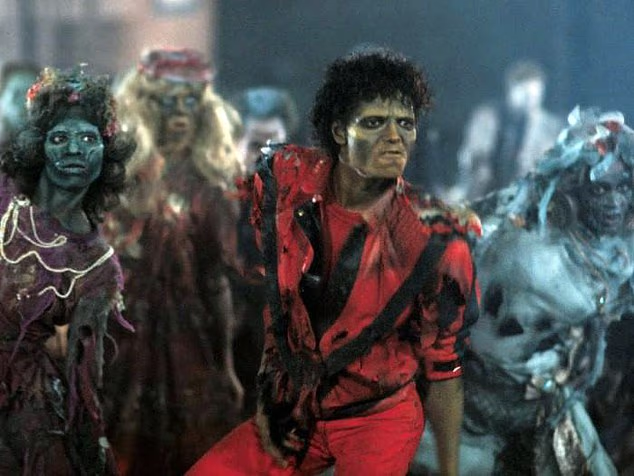
The video age was still in its infancy when Michael Jackson – already a superstar through his work with the Jackson 5 – returned with Thriller in 1983
The video age was still in its infancy when Michael Jackson – already a superstar through his work with the Jackson 5 – returned with Thriller, his second solo album, in 1982.
But it was the single release of the album’s title track the following year, accompanied by a sprawling, 14 minute video directed by John Landis and released on MTV that really catapulted Jackson into the stratosphere.
Inspired by Landis and his work on 1981 horror film An American Werewolf In London, the enigmatic singer was given a $50000 budget – significantly more than any other artist at the time – to launch the track alongside a spooky, Halloween themed film short.
And what a film it would prove to be.
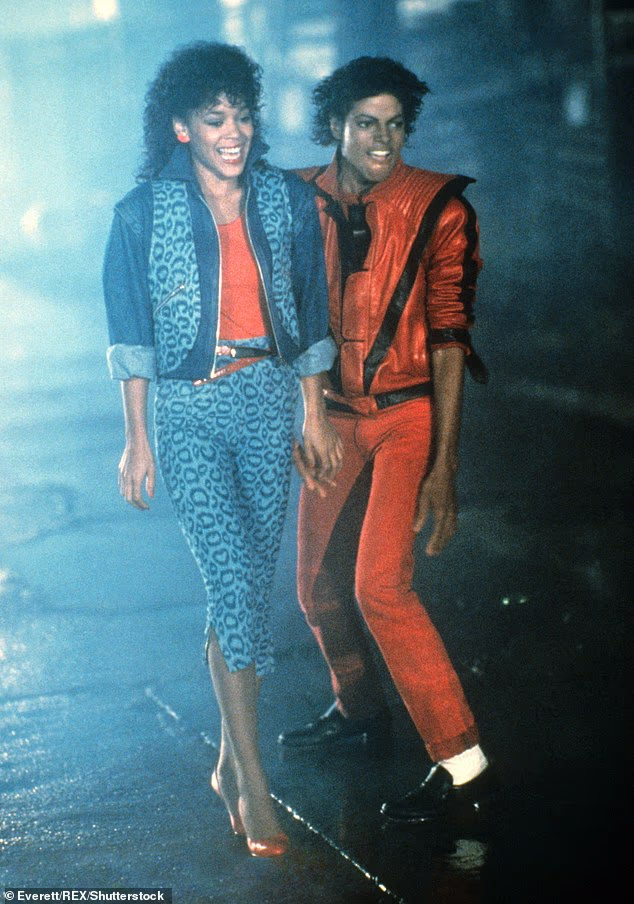
From Jackson’s red leather jacket and eerily prescient admission that he’s ‘not like other guys,’ Thriller redefined the music video at a time when it was still gaining traction
From Jackson’s red leather jacket and eerily prescient admission that he’s ‘not like other guys,’ to Vincent Price’s foreboding narration and that iconic zombie dance, Thriller redefined the music video at a time when it was still gaining traction as a popular medium.
Indeed, both Jackson and Landis turned music video filmmaking into a serious art-form following its MTV release on December 2, 1983, alongside the documentary Making Michael Jackson’s Thriller.
Such was the overwhelming demand for the video that MTV were forced to advertise when they would next play it, with each broadcast taking viewing figures into the multi-millions.
Airing just months after David Bowie criticised the channel for failing to promote black artists, Thriller helped MTV break down racial barriers for black artists while revolutionising music video production.
SINEAD O’CONNOR’S TEARS (1990)
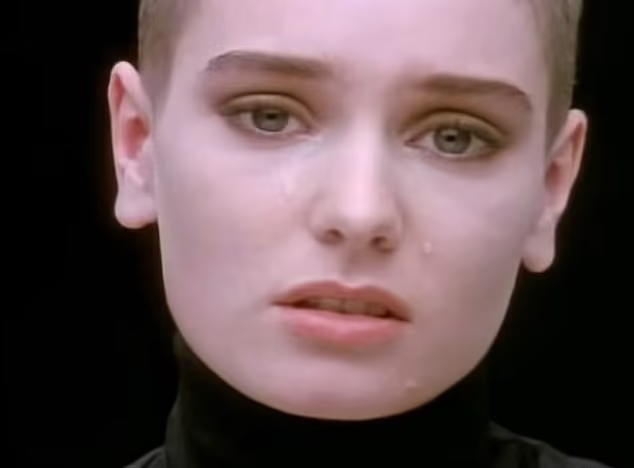
The song was written by Prince, but it would be Sinead O’Connor’s tears and repeated broadcasts by MTV that turned Nothing Compares 2 U into an era-defining moment
The song was written by Prince, but it would be Sinead O’Connor’s raw emotion and repeated broadcasts by MTV that turned Nothing Compares 2 U and its accompanying music video into an era-defining moment.
Directed by John Maybury and relying almost entirely on extreme close-ups of O’Connor’s face, it served as a contrast to the elaborate cinema used to great effect in Michael Jackson’s Thriller several years earlier.
But if this particular video was less popular following its MTV premiere in 1990, it was only marginally so, thanks to the two single tears that roll down the singer’s cheeks as it draws to a close.
O’Connor later admitted the moment was unplanned, with Maybury capturing her expression while caught in the song’s emotional climax.
She recalled: ‘I didn’t know I was going to cry when I sang in the video because I didn’t cry in the studio recording it. I think it happened because there was a big eye on me, recording me.
‘Every time I sing that song I think of my mother. I never stop crying for my mother. I couldn’t face being in Ireland for 13 years because of it.
‘I cut myself off. I never called home and it took me 25 years to stop crying. I was thinking of her my subconscious was also thinking of that little girl out in the garden.’
She added: ‘I think it’s funny that the whole world fell in love with me because of that crying in the video. I then went and did lots of crying and everyone said “you crazy b**ch” but they fell in love with that tear because it was a mirror on themselves.’
The video would go onto win three Moonmen at the 1990 MTV Video Music Awards.
THE BIRTH OF BEAVIS AND BUTT-HEAD (1993)

A crudely drawn representation of Gen X adolescence, Beavis and Butt-Head spent several successful years on the channel and even served as the inspiration for a feature length film
Nirvana and Pearl Jam were staking a claim as the biggest American rock bands of the decade and Oasis was just an affordable high street clothes shop when MTV introduced us to two animated, couch-bound slackers in 1993.
A crudely drawn representation of Gen X adolescence, the uncouth Beavis and Butt-Head spent several successful years on the channel and even served as the inspiration for a feature length film.
But it would be their off-hand music video reviews, conducted from their fictional Texas home, that boosted the troublesome double-act’s popularity among MTV viewers.
Created and voiced by Mike Judge, the blunt commentary – interspersed between the latest music videos – would serve as the show’s foundation and often provided some of its more memorable moments, including their fondness for headbanging.
Despite its irreverence, Beavis and Butt-Head would become one of MTV’s highest rated shows, with Rolling Stone describing it as the “biggest phenomenon on MTV since the heyday of Michael Jackson.”‘
ROBERT PALMER AND HIS BAND OF MODELS (1986)
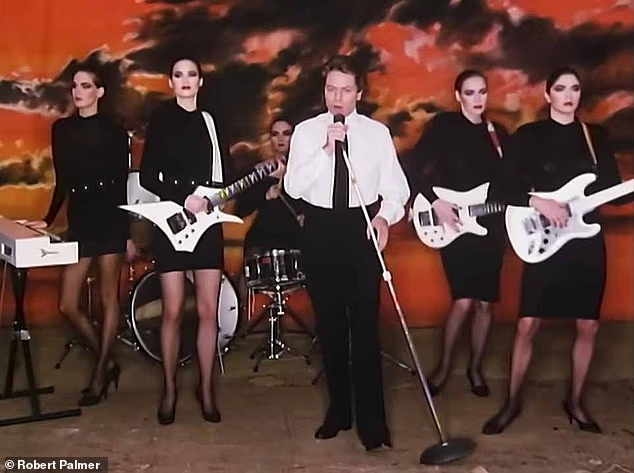
At face value it’s just a singer and his band, but when the band has been substituted for five pale-skinned, statuesque and seductively dressed models we have a completely different video on our hands
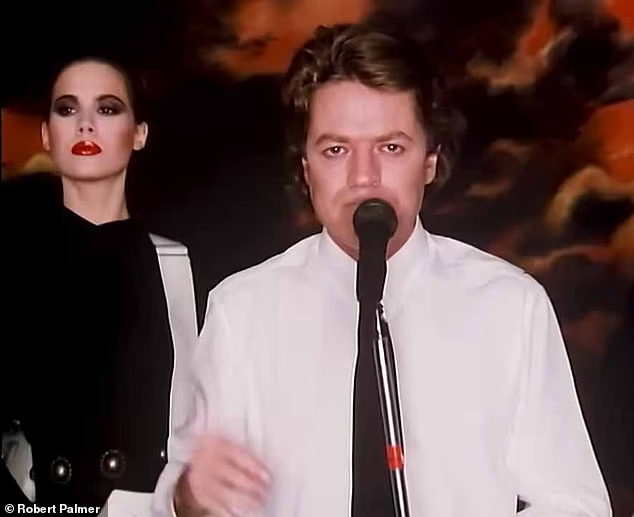
So it proved in 1986, when Robert Palmer released the promotional video for what would arguably become his best known single – the instantly catchy Addicted To Love – on MTV
At face value it’s just a singer and his band, but when the band has been substituted for five pale-skinned, statuesque and seductively dressed models we have a completely different video on our hands.
So it proved in 1986, when Robert Palmer released the promotional video for what would arguably become his best known single – the instantly catchy Addicted To Love.
Looking characteristically sharp in a crisp white shirt and tie, Palmer sings to director Terence Donovan’s camera while his makeshift band performs in the background.
A simple premise, you might say, but Palmer’s now iconic video, with its stylish clothes and slick presentation, defined MTV during its mid ’80s peak more than any other single at the time.
Rock band Van Halen later performed the first verse of the song during the 1986 MTV Video Music Awards, with the song earning Palmer a Moonman for Best Male Video.