Archaeologists have proven the existence of a lost ring of pits near Stonehenge, and say it could be Britain’s largest prehistoric structure.
The ring of more than 20 pits, some of which are 10 metres deep and five metres wide, extends in an arc more than a mile across.
At their centre are the ancient sites of Durrington Walls and Woodhenge, 1.8 miles (2.9 kilometres) northeast of Stonehenge, where the henge builders held ritual feasts.
Using an array of novel scientific techniques, researchers now say that these pits were likely constructed by Neolithic people around 4,500 years ago.
Researchers say that carving the pits into Wiltshire’s chalky ground would have taken an enormous amount of planning and effort.
Lead researcher Professor Vincent Gaffney, of the University of Bradford, told the Daily Mail that the vast structure was a ‘cosmological statement’.
He says: ‘They link Durrington walls henge and another site at Larkhill – a causewayed enclosure about a thousand years earlier. ‘
‘And in doing so, inscribed a boundary into the landscape – setting aside an area of special significance.’
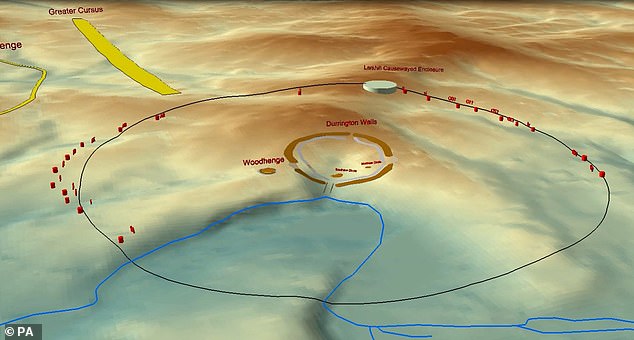
Scientists have proven the existence of a lost ring of pits nearby Stonehenge, which is likely the UK’s largest prehistoric monument

The pits surround ancient sites of Durrington Walls and Woodhenge, 1.8 miles (2.9 kilometres) northeast of Stonehenge (pictured). These sites are believed to be where the Stonehenge builders held ritual feasts
The pits surrounding Durrington Walls were first found in 2020, and were immediately hailed as one of Britain’s most impressive ancient sites.
The discovery of the pit circle appeared to further cement the Salisbury Plane’s reputation as a uniquely important religious site for Britain’s Neolithic people.
This area is not only home to Stonehenge, but also a wider series of interconnected ceremonial structures, stone circles, and cemeteries from the Stone Age.
Durrington Walls, which sits at the epicentre of the pit circle, is a ‘superhenge’ that is believed to be the largest anywhere in the UK.
Likewise, the nearby ‘Woodhenge’ was an enormous timber monument built around 2500 BC, consisting of six concentric rings of posts of varying size forming an oval monument 40 metres across.
However, scientists have questioned whether the pits were really dug by humans or whether they might have been natural features of the landscape.
In a new research paper, titled ‘The Perils of Pits’, Professor Gaffney and his co–authors present a new batch of scientific evidence to prove the pits’ human origins.
Since no one technique could answer all of their questions, the researchers deployed an array of techniques to work out the exact structure of the pits.
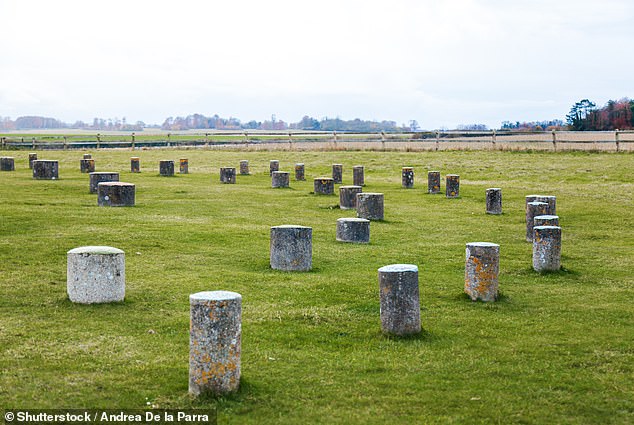
The pits encircle the ancient sites of Durrington Walls and Woodhenge. Woodhenge was an enormous timber monument built around 2500 BC, consisting of six concentric rings of posts of varying size forming an oval monument 40 metres across. Pictured: Stone pillars marking the locations of Woodhenge’s timber posts
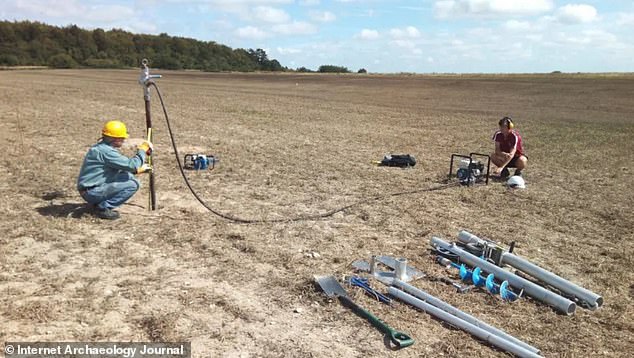
Scientists had questioned whether the pits were really man–made. So scientists used an array of scientific tests to work out their exact shape and structure
First, they used a technique called electrical resistance tomography, which measures changes in electrical resistance at the surface to work out the size of underground structures.
Then, radar and magnetic imaging were used to assess their depth and shape.
‘This in itself did not prove these features to be man–made,’ says Professor Gaffney.
‘So sediment cores were extracted and an array of techniques, including novel geochemistry, were used to characterise the nature of the soils.’
‘Optically stimulated luminescence’ was used to work out the last time that the soils were exposed to the sun, and ‘sedDNA’ to extract plant and animal DNA directly from the dirt.
This revealed that each pit had the same pattern of repeating layers, starting in the late Neolithic period – something that would be extremely unlikely to happen naturally.
These techniques also identified the DNA of sheep and cattle, which suggests that the pit circle was being occupied and farmed at the time.
Professor Gaffney says: ‘It confirms that this structure – probably the largest prehistoric monument in Britain at least – is a purposefully constructed monument in a landscape which is itself exceptional.’
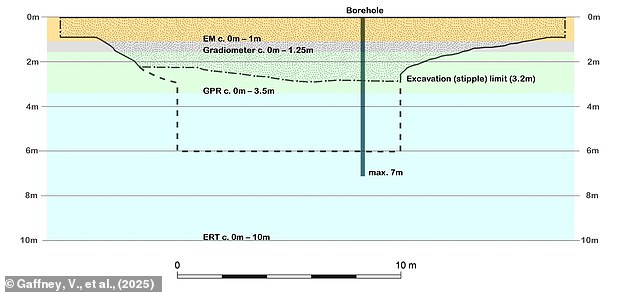
The researchers used a technique called electrical resistance tomography, which measures changes in electrical resistance at the surface to work out the size of underground structures (illustrated)
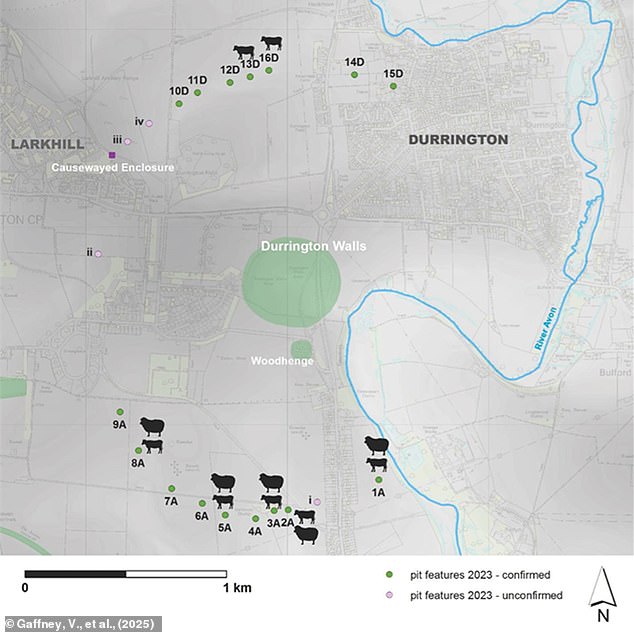
The researchers found that the pits had a consistent pattern of layers and even contained DNA of cattle and sheep. This suggests that they were deliberately built by humans
By showing that these vast pits were carved by humans, the researchers have shown that Britain’s ancient people were much more organised than had previously been believed.
‘The size of the structure demonstrates the society they lived in was capable of planning and motivating large numbers of people for religious purposes,’ says Professor Gaffney.
The pit circle is so large that you cannot see across to the other side, but still traces a near–perfect circle around Durrington Walls.
This regularity suggests that the pits must have been laid out by pacing, which implies that the people of ancient Britain had a numerical system for counting.
If true, this could be some of the very earliest evidence for the ability to count in Neolithic Britain.
However, Professor Gaffney says we will ‘probably not’ ever know exactly why these pits were built.
The Stonehenge monument standing today was the final stage of a four part building project that ended 3,500 years ago
Stonehenge is one of the most prominent prehistoric monuments in Britain. The Stonehenge that can be seen today is the final stage that was completed about 3,500 years ago.
According to the monument’s website, Stonehenge was built in four stages:
First stage: The first version of Stonehenge was a large earthwork or Henge, comprising a ditch, bank and the Aubrey holes, all probably built around 3100 BC.
The Aubrey holes are round pits in the chalk, about one metre (3.3 feet) wide and deep, with steep sides and flat bottoms.

Stonehenge (pictured) is one of the most prominent prehistoric monuments in Britain
They form a circle about 86.6 metres (284 feet) in diameter.
Excavations revealed cremated human bones in some of the chalk filling, but the holes themselves were likely not made to be used as graves, but as part of a religious ceremony.
After this first stage, Stonehenge was abandoned and left untouched for more than 1,000 years.
Second stage: The second and most dramatic stage of Stonehenge started around 2150 years BC, when about 82 bluestones from the Preseli mountains in south-west Wales were transported to the site. It’s thought that the stones, some of which weigh four tonnes each, were dragged on rollers and sledges to the waters at Milford Haven, where they were loaded onto rafts.
They were carried on water along the south coast of Wales and up the rivers Avon and Frome, before being dragged overland again near Warminster and Wiltshire.
The final stage of the journey was mainly by water, down the river Wylye to Salisbury, then the Salisbury Avon to west Amesbury.
The journey spanned nearly 240 miles, and once at the site, the stones were set up in the centre to form an incomplete double circle.
During the same period, the original entrance was widened and a pair of Heel Stones were erected. The nearer part of the Avenue, connecting Stonehenge with the River Avon, was built aligned with the midsummer sunrise.
Third stage: The third stage of Stonehenge, which took place about 2000 years BC, saw the arrival of the sarsen stones (a type of sandstone), which were larger than the bluestones.
They were likely brought from the Marlborough Downs (40 kilometres, or 25 miles, north of Stonehenge).
The largest of the sarsen stones transported to Stonehenge weighs 50 tonnes, and transportation by water would not have been possible, so it’s suspected that they were transported using sledges and ropes.
Calculations have shown that it would have taken 500 men using leather ropes to pull one stone, with an extra 100 men needed to lay the rollers in front of the sledge.
These stones were arranged in an outer circle with a continuous run of lintels – horizontal supports.
Inside the circle, five trilithons – structures consisting of two upright stones and a third across the top as a lintel – were placed in a horseshoe arrangement, which can still be seen today.
Final stage: The fourth and final stage took place just after 1500 years BC, when the smaller bluestones were rearranged in the horseshoe and circle that can be seen today.
The original number of stones in the bluestone circle was probably around 60, but these have since been removed or broken up. Some remain as stumps below ground level.
Source: Stonehenge.co.uk