Those blood-streaked bedroom walls. The brassiere, with its strap sliced off, discarded on the floor. Her foot protruding from beneath a rumpled duvet.
Uncovered 18 years ago last week, this was the heart-rending first forensic snapshot of Meredith Kercher’s murder – a scene that the man who ordered that grisly photograph to be taken still can’t erase from his memory.
‘It was the sheer ferocity that shocked me,’ says retired Italian prosecutor Giuliano Mignini, as we prepare to revisit the hillside house in Perugia where the 21-year-old Home Counties exchange student was raped and repeatedly stabbed in her bedroom.
‘The violence was so extreme that I have deja vu moments because of what I saw: bad sensations and feelings when I go to certain places. It stays in my mind a lot.’
The last time I saw Mignini, whose outrage at the murder was heightened because he had four daughters of a similar age, he was in his fearsome prime, breathing fire and brimstone in this medieval city’s cavernous courtroom.
The targets for his rhetoric were the then-notorious Amanda ‘Foxy’ Knox, whom he cast as Meredith’s cold-hearted and vampish American housemate, and her Harry Potter-lookalike boyfriend Raffaele Sollecito. He accused the pair of murdering Meredith while acting out a violently erotic fantasy.
Today, 14 years after that dramatic trial, and with his physical powers considerably diminished, it still pains him that he failed to convince the judges of his theory, which turned the case into a global sensation and still evokes endless debate among keyboard detectives.
But what troubles this rheumy-eyed man of 75 most, he tells me, is that he delivered only partial justice to Meredith’s parents, John and Arline Kercher, both of whom have since died, and her three siblings, Stephanie, now 42, John, 49, and Lyle, 46.

American student Amanda Knox, pictured at court in Italy 2008, was eventually exonerated

Meredith Kercher was raped and repeatedly stabbed in the ferocious attack 18 years ago
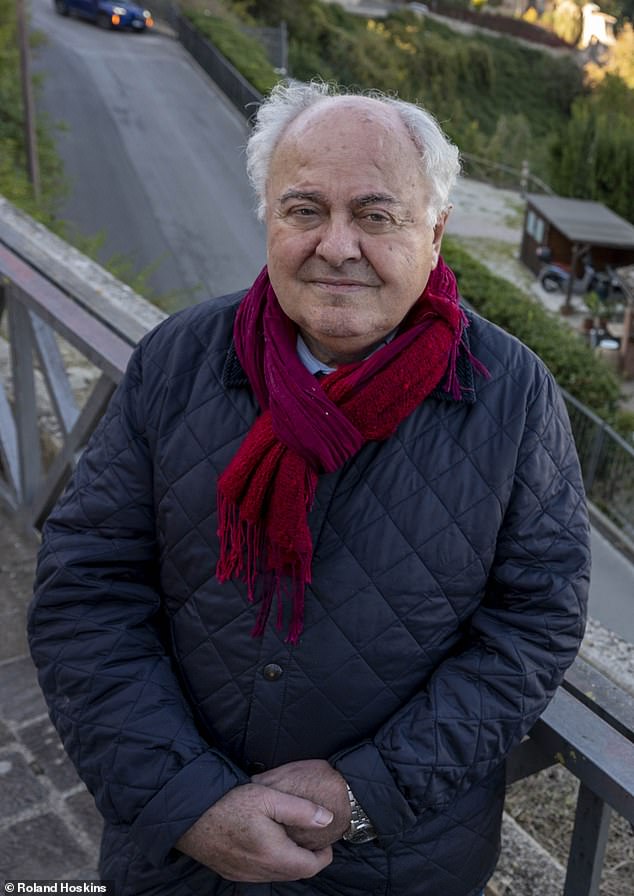
Retired prosecutor Giuliano Mignini in Perugia. Some 14 years have passed since the trial
Though Mignini secured the conviction of the third accused, Rudy Guede (now free after serving just 13 years of a 16-year sentence, but currently on trial for sexually assaulting his ex-girlfriend) he remains convinced that the Ivory Coast-born miscreant didn’t act alone.
He also recriminates with himself for failing to uncover the full truth behind the savage end of a girl he never knew but came to admire for her warmth and intelligence, as well as her beauty.
However, as he told me with ill-concealed pleasure when we met this week, five years into his retirement, Mignini, who also directed the police investigation into the murder, believes he may at last have found a breakthrough.
In America, Knox’s homeland, he was cast as the devil incarnate for defaming her as a debauched siren: Donald Trump wrote to him saying it was he who should be jailed, he snorts. But in Italy his reputation as a scourge of vice and violence still goes before him.
Particularly in Perugia, where people jeered and spat at Knox as she left the courthouse after her 2009 conviction was overturned, then flew back to the U.S on a TV network’s private plane and began cashing in on her dubious celebrity via books, interviews and films documenting her ordeal.
Locals still stop him in the street with fresh snippets of information about the murder, Mignini tells me, but usually it adds little of value to the story.
Earlier this year, though, a contact brokered a meeting with a potentially vital female source.
This woman told him that in 2007 she had a ‘relationship’ with someone who had been inside 7 Via Della Pergola, the house Meredith shared with Knox and several other young people, on the night she died. Mignini met her in a bar near the University for Foreigners, where Meredith and Knox were studying, and they talked for three hours, he says.
‘After 18 years, she had come looking for me. She said she didn’t speak out at the time because she was scared, and that even after so many years she was still frightened. But the person she was in a relationship with had told her the whole story, and she had always felt guilty [for not coming forward]. When she saw me giving a recent interview on TV, she decided it was time to speak.’
Mignini says his source – a ‘good’ and credible middle-aged woman still living in Perugia – gave him the person’s full name, which he has handed over to the police, together with notes made during the meeting.
He declined to give me more details, or even confirm the mystery person’s gender, but admitted they were someone he had completely ‘overlooked’ at the time, prompting him to rethink the investigation. It was now vital to establish whether this person was a witness to the murder or had participated in it.
He claims the authorities are taking an interest in this new information, but his successor, Raffaele Cantone refutes this.
‘Mr Mignini is not a judge any more. I’m the chief prosecutor here,’ he said curtly this week.
‘He can pass this information on as a private citizen, but there is nothing new to investigate. The case is closed.’
To which Mignini responds: ‘Well, if they were looking into the case again, they wouldn’t tell a journalist.’
The Kercher family’s lawyer, Francesco Maresca, is also sceptical. For as he has explained to Meredeth’s sister, Stephanie, it would be ‘a very hard road’ to secure a new trial, even if the information were true.
Nonetheless, Maresca points out, Guede was convicted of murdering Meredith with at least one accomplice: someone who must remain at large and is not Knox or Sollecito, whose innocence has been established beyond doubt by Italy’s highest court.
So, could Guede’s accomplice be the person named by the retired prosecutor’s source?
Sollecito’s lawyer, Luca Maori, dismisses this suggestion. For all the hoopla surrounding the case, he told me in his office in Perugia, it was essentially a ‘simple crime’.
Guede, a cat-burglar who had previously hung out with the young occupants of the house, broke in that night intending to steal. However, when he happened upon Meredith lust overcame him, and when she repelled him, he raped her and slit her throat.
‘Mignini is obsessed with this case, and everything he investigates he thinks it’s about sex and orgies,’ Maori told me dismissively.
Whether or not this is fair, Mignini’s view of Knox has softened drastically since he castigated her in that oppressive underground courtroom 14 years ago.
From the moment he first saw her smooching with Sollecito – a scene famously captured on TV news footage – as detectives combed the murder scene, he disapprovingly regarded her as an unfeeling libertine: the antithesis of the demure British victim.
This stereotype gathered momentum when her pink vibrator with bunny rabbit ears was found on display in the bathroom and when, a couple of days after her friend’s death, she went shopping for lingerie.
The alibi she gave – that she and her boyfriend of just five days had spent the evening of the murder smoking dope and making love at his digs – and her habit of relieving her stress with yoga poses in the police station seemed to tell church-going family man Mignini the kind of girl he might be dealing with.
With the case making lurid headlines, and Perugia’s 30,000 students living with the fear that a maniac was stalking its labyrinthine cobbled streets, he was under pressure to resolve the case quickly, and within days she and Sollecito were charged.
It would be eight years – four of which they spent in prison – and three trials before, lambasting ‘sensational failures’ and ‘investigative amnesia’ in the police and forensics work, the Supreme Court declared them innocent. Mignini refuses to accept that he and his team made mistakes. Following an extraordinary reconciliation with Knox, however, he now sees her in an entirely different – almost avuncular – light.
They met in 2022, after Knox, now 38 and a mother of two, sought a rapprochement with the ringleader of her tormentors via WhatsApp messages and emails.
Knox has explained her strange decision as cathartic: a primal urge to exorcise the ‘bogeyman’ who fought to have her jailed for 26 years, in the hope of correcting his ill-formed opinion of her.
However, Mignini admits to having a more hard-headed motive for accepting her entreaty. Still convinced she played some part in the murder, he thought he might lure her into revealing unknown details to him.
The first meeting, at a religious institution near Perugia, lasted for several hours spanning lunch, and as they talked, a mutually trusted priest sat with them.
‘I don’t know why we got into this relationship but maybe it was like Stockholm Syndrome [where a prisoner bonds with their captor],’ he surmises.
‘During the trial I often noticed Amanda gazing at me with an imploring look in her eye, as if she wanted to ask me something, but then we were in a big conflict.
‘When we met, it was very moving. Amanda held my hand and cried a lot. I don’t know why, but she said she had come to trust me.’
Knox evidently won him over, too. While many people in Perugia portrayed her as ‘a prostitute’, he now realised that this opinion was born of a ‘cultural division’ between Catholic Italy and the freewheeling US. ‘As I came to understand her more, I realised she was just a typical West Coast girl with ways that seemed strange to Italians. And she was so young [when Meredith was murdered], only 20 years old.’
When Mignini tried to steer their conversation on to the crime, however, asking for instance whether Guede’s confessed attraction to her was reciprocated, he says Knox refused to engage with him. She was similarly unforthcoming when he suggested that her habit of putting her hands over her ears under police questioning had betrayed the fact that she heard Meredith’s final screams.
‘Amanda wanted to convince me that she was a good girl. She was probably hoping I would beg her to accept my apology, but that was never going to happen,’ Mignini says. ‘She wanted me to say I’d made a big mistake, and she kept restating her innocence, but I’m still convinced she was lying.’
Despite this, he admits to developing a fondness for her. They found shared interests in James Bond films, The Beatles and The Lord Of The Rings.
Knox returned to Italy in June, in a failed attempt to overturn her conviction for slandering bar owner Patrick Lumumba, whom she falsely accused of Meredith’s murder when she was being questioned by police in 2007, and she and Mignini met again socially.
That day many years ago, Mignini’s father died suddenly, on his way to see Puccini’s opera Damsel Of The West, set in Gold Rush California; so in their messages he now jokingly calls Knox his Golden Girl of the West.
‘So, I think Amanda is very nice, but I still think she was guilty, although not of the murder itself. But she was young, she didn’t understand what was going on. I think she saw it, and then she escaped.’
Though Italy’s Supreme Court of Cassation, in its final judgment in 2015, rejected the prosecution’s claim that Knox and Sollecito were involved, it left open the possibility that they were in the house, adding that some circumstances might never be known.
Mignini cites this observation when describing the new person of interest – who apparently fled Italy shortly after the murder – as ‘the fourth person’ in the story.
However, though his source claims to have known Knox and Sollecito, he says she told him nothing that might call their innocence into question.
So there, at least for now, this tortuous matter rests.
As the Kerchers’ lawyer remarks, with Meredith’s family grieving the 18th anniversary of her passing, Mignini could hardly have revealed his meeting – in an interview with the Italian newspaper La Stampa – at a more emotional time.
Gazing down at the pretty Umbrian villa where this ghastly saga began, however, the former prosecutor expresses the hope that his new informer might yet bring them the truth, and with it closure.
She is now ready to inform the police, he says, and ‘if someone speaks to her, we might find out what really happened that night. I really hope we will, because Meredith was a beautiful person and having met her family, I know they are impeccable people.’
Had his recent bar-room tryst with that unnamed source caused him to doubt his theory? Not least his apparent rush to judge Amanda Knox, whose eccentric behaviour, in those long ago November days, has since been accepted by the Supreme Court as a probable symptom of her youthful anxiety?
He removes his thin-rimmed glasses and rubs his eyes. ‘No’, he says, ‘I’m satisfied with my investigation, but I feel sorry about this case now because I understand there could have been much more to it.’
As those of us who trawled the conspiratorial backstreets of Perugia in search of clues to a crime whose depravity defied belief will roundly concur, there could indeed.
Additional reporting by Cristina Cennamo