Gerry Adams at London trial to ‘assert legitimacy of the republican cause’ | UK News
Gerry Adams has said he came to London’s High Court “to assert the legitimacy of the republican cause” and “reject the allegations” he was behind three IRA bombings.
Three men injured in those incidents accuse the former Sinn Fein president of having been a top member of the Provisional IRA at the time.
Mr Adams told the civil trial earlier this week he had “no involvement whatsoever” in the bombings and was never a member of the terrorist group.
Speaking on Thursday, he said Irish people had had “a bad experience of British courts, Irish republicans especially”.
“I came to London to reject the allegations levelled against me,” he added. “And to assert the legitimacy of the republican cause and the right of the people of Ireland to be free.
“I am also here out of respect for the claimants. I am very mindful of the many other victims of the conflict.
“They too deserve our respect. Thankfully the war has been ended.”
The three people who have brought the case are John Clark, a victim of the 1973 Old Bailey bombing; Jonathan Ganesh, a 1996 Docklands bombing victim; and Barry Laycock, a victim of the 1996 Manchester bombing.
Mr Adams, 77, was president of the Irish republican party Sinn Fein from 1983 to 2018.
His lawyer asked why the men – who are seeking a token £1 in damages – had waited so long to bring the case and argued it should be dismissed.
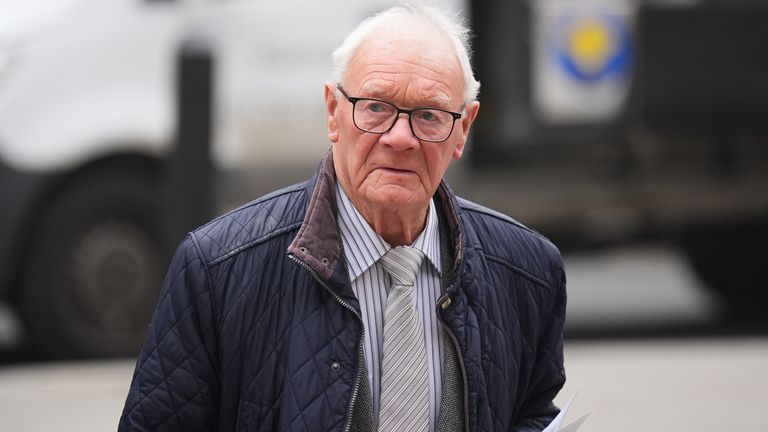
Barry Laycock was injured when the IRA bombed Manchester city centre. Pic: PA
Edward Craven KC said Mr Clark’s claim came with a delay “genuinely unprecedented in magnitude”.
He told the court: “We say the very brief and bald hearsay evidence you have been provided with falls a long way short of the kind of explanation that ought to be provided for a delay of this length.”
Mr Craven suggested the men were using the trial, which a judge alone will decide on, as a way of trying to have a “public-style inquiry”.
“One of the concerns we have had throughout is that the claim is being used as a vehicle for a much wider examination of Mr Adams’s alleged role and actions,” he said.
He asked the court to instead focus only on the three bombings in question.
Anne Studd KC, who is representing the men, said it would be unfair if the case were thrown out over this point.
“It is arguable and legally unobjectionable, and these claimants are entitled to pursue it,” she said.
Ms Studd said earlier in the trial that a “jigsaw” of evidence would prove Mr Adams had been a senior member.
A former British intelligence officer told the court last week he believed Mr Adams wouldn’t have been able to achieve his political wins if he hadn’t been in the IRA’s army council.
A second officer added: “Had the defendant not been the senior figure in the IRA that he was, there would have been absolutely no point in the British, Irish and United States governments dealing with him the way they did on the road to the Good Friday Agreement in 1998.”
The Provisional IRA formally ended its armed campaign for Irish unification in 2005.
Mr Adams’s trial is expected to finish on Friday.