US military to ‘escort’ oil tankers on Strait of Hormuz amid market volatility, Treasury Secretary confirms
American naval forces will provide protection for oil tankers attempting to navigate through the Strait of Hormuz once military conditions allow it, US Treasury Secretary Scott Bessent has confirmed.
This latest intervention from Mr Besent comes amid a spike in oil prices and widespread stock market volatility following President Donald Trump and Israel’s military action against Iran.
In response to the death of Ayatollah Ali Khamenei, the Islamic Republic has launched missile strikes on US military bases and energy infrastructure across the Guld, as well as closing off the Strait of Hormuz.
Some 20 per cent of the world’s oil imports pass through this shipping passage, with Iran’s decision to prevent tankers from crossing the route having a major effect on the global economy.

US military to ‘escort’ oil tankers on Strait of Hormuz amid market volatility, Treasury Secretary confirms
|
GETTY / SKY NEWS
In an interview with Sky News, Mr Bessent stated: “My belief is that as soon as it is militarily possible, the US Navy, perhaps with an international coalition, will be escorting vessels through.”
The Treasury Secretary pointed to evidence that the strategic waterway remains navigable, noting that Iranian vessels and Chinese-flagged tankers have successfully passed through recently. “So we know that they have not mined the straits,” he added.
During the interview, Mr Bessent was summoned to the White House Situation Room, and when pressed on whether escort operations had been discussed, he responded cryptically: “Your words, not mine.”
Iran’s new Supreme Leader Mojtaba Khamenei has indicated he intends to leverage the effective closure of the vital shipping route against the United States and Israel.
 Mojtaba Khamenei will be Iran’s new supreme leader | GETTY
 The Strait of Hormuz is one of the most important shipping routes in the world, especially for oil exports | GETTY
As the conflict approaches its second week, Mr Khamenei delivered a defiant address vowing retribution for US-Israeli military action, declaring he “will not refrain from avenging” the blood of their “martyrs”.
Persistent Iranian strikes on Gulf shipping and energy facilities have driven crude prices back above $100 per barrel, triggering stock market falls globally on Thursday.
The price surge occurred despite an announcement the previous day that developed nations would release 400 million barrels from strategic reserves, with nearly half coming from American stockpiles. Mr Bessent disclosed that the war has cost Washington approximately $11billion (£8.25billion) thus far.
Mr Bessent, a former London resident, said the Prime Minister’s decision had hindered military planning, with the main concern centring on access to Diego Garcia.
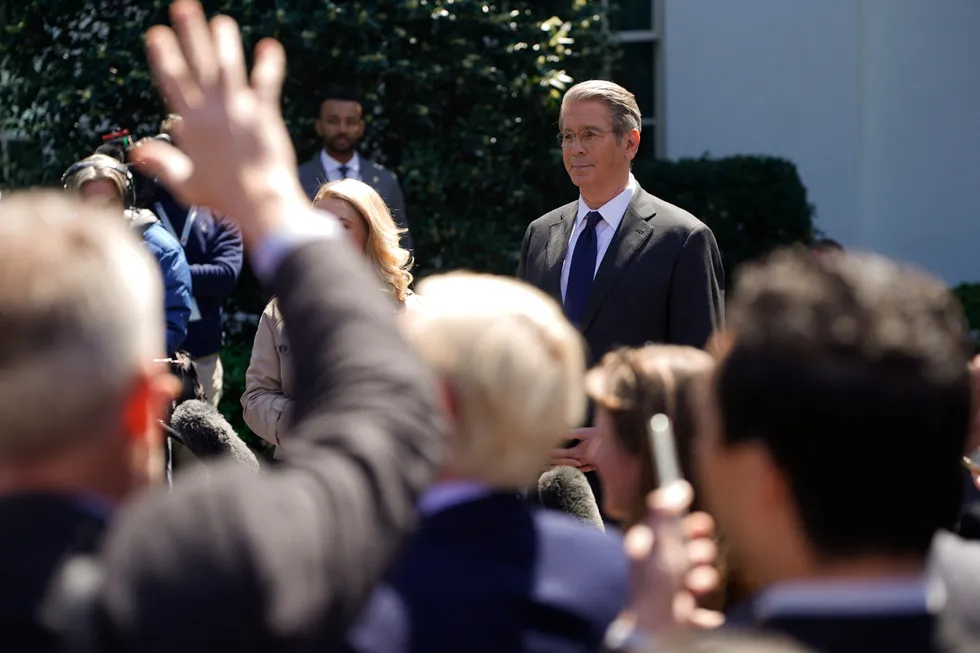 Treasury Secretary Scott Bessent speaks with the media about tariffs at the White House | Reuters
“We delayed being able to fully implement the military plan,” he explained, adding that US B-2 bombers were forced to undertake 37-hour round-trip missions requiring constant refuelling, rather than flights of approximately three to three-and-a-half hours.
He described President Trump’s solemn commitment to protecting American servicemen, observing that “anything that upsets that, upsets him, and I think that’s what got the very strong reaction.”
Despite the tensions, Mr Bessent acknowledged the enduring bond between the two nations, describing it as a “great historical relationship.” Mr Starmer subsequently authorised American use of British facilities for defensive operations targeting Iranian missile installations.
When asked about the current state of relations between Mr Trump and the Prime Minister, Mr Bessent noted: “Belatedly, the prime minister offered to put resources in the region. We have a long-term relationship.”
The Treasury Secretary expressed confidence that the alliance would recover, predicting that while there may be “some bumps in the road,” the relationship will “eventually get back on track.” Mr Trump had criticised Britain last week, declaring the US does not require allies who “join wars after we’ve already won.”