UK inflation could surge above five per cent as US-Iran war drives energy prices higher
Inflation could surge back above five per cent as the oil crisis sends fresh shockwaves through the UK economy.
Economists warn the surge in energy prices could force the Bank of England to reconsider its plans to cut interest rates.
UK inflation could climb above five per cent if escalating tensions in the Middle East push global oil and gas prices higher, according to analysts at Morgan Stanley.
The bank warned that inflation could breach this level if Strait of Hormuz remains effectively closed for a month or longer, disrupting global energy supplies and putting further pressure on Britain’s economy.
Higher energy prices would not only increase costs at the petrol pump but could also drive up household bills. Bruna Skarica, the bank’s chief UK economist, said the energy price cap could rise by around 20 per cent when it is reset in July.
Such an increase would lift the average annual bill from April’s cap of £1,641 to roughly £1,970. Further increases could follow in October as European countries refill gas storage over the summer, keeping wholesale prices elevated.
Inflation had previously been expected to fall from around three per cent towards the Bank of England’s two per cent target in the coming months.
However, a surge to five per cent would push inflation to its highest level since September 2023, when the UK was still dealing with soaring energy costs following Russian invasion of Ukraine.
Markets have already reacted to the risk of higher inflation, with traders increasingly betting that the Bank of England may need to keep interest rates higher for longer.
The scale of the economic impact will largely depend on how long energy supplies remain disrupted and whether oil and gas prices stay elevated. Skarica warned that if prices remain at current levels, economic activity could slow significantly from the second half of 2026.
Traders in money markets now believe there is up to a 75 per cent chance that policymakers could raise borrowing costs back to four per cent before the end of 2026.

Bank of England under pressure as inflation could rise ‘back above 5 per cent’
|
GETTYThe dramatic shift in expectations followed Brent crude surging by nearly 30 per cent overnight to almost $120 per barrel, its highest level since 2022.
Just days ago, before US and Israeli military action against Iran, traders had assigned an 80 per cent likelihood to a rate cut at the Bank’s next meeting.
George Cole, an economist at Goldman Sachs, said interest rate rises “are possible under scenarios of much higher commodity prices”.
Economists warned that UK inflation could surge back above five per cent if elevated energy prices persist, more than doubling the Bank’s two per cent target.RSM UK economist Tom Pugh said the latest spike in oil and gas prices meant the UK “is looking at inflation back above five per cent.”
The doubling of natural gas prices alone would contribute three percentage points to inflation, with oil adding at least another half a percentage point, according to his analysis.
ING economist James Smith calculated that price growth would reach 4.7 per cent by September should the oil surge continue through the second quarter.
The potential inflation rebound represents a significant setback for the Bank, which had anticipated hitting its target this spring before the conflict erupted.
Chancellor Rachel Reeves is maintaining daily contact with Bank of England Governor Andrew Bailey as the government monitors the unfolding energy crisis.
Prime Minister Sir Keir Starmer confirmed the close coordination on Monday, stating that ministers are working across departments and with international partners to mitigate the economic fallout.
“The job of government is obviously to get ahead, to look around the corner, to work with others,” Mr Starmer said.
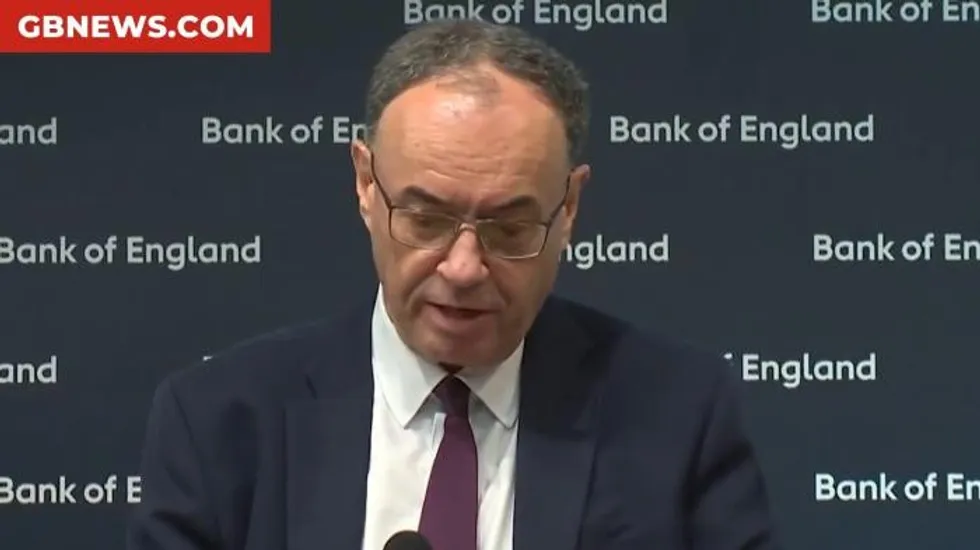
The potential inflation rebound represents a significant setback for the Bank
|
Bank of EnglandThe Chancellor will participate in discussions with G7 finance ministers later today regarding the potential release of global oil reserves to alleviate the supply shock.
The escalation of hostilities and ongoing disruption to shipping through the Strait of Hormuz, which handles roughly a fifth of global crude oil flows, has alarmed both the City and Whitehall.
Five-year swap rates, a crucial benchmark for mortgage pricing, climbed above 4 per cent on Monday for the first time in twelve months.

The average interest rate on two-year fixed mortgage deals has already crept up from 4.82 per cent to 4.87 per cent within the past week
|
GETTYThe average interest rate on two-year fixed mortgage deals has already crept up from 4.82 per cent to 4.87 per cent within the past week.
Matt Cairns, head of fixed income strategy at Rabobank, said the “pivotal question is how deep and prolonged” the Middle East conflict becomes.
“Even with the global economy’s lower sensitivity to energy shocks and more diversified gas sourcing, a sustained rise in prices would still act as a tax on consumers and corporates,” he added.
Mr Smith noted that the duration of elevated prices matters more than peak levels, given the UK’s household energy price cap averages wholesale costs over three months.