The UK’s delicate deal to get the Bayeux Tapestry loaned from France – a diplomatic coup or cultural gamble? | Ents & Arts News
When the Bayeux Tapestry goes on show at the British Museum later this year it will be the culmination of one of the most impressive cultural exchanges this century.
Nearly a thousand years old, the tapestry is one of the earliest visual stories in Europe. A medieval graphic novel, if you like, that’s shaped how we remember 1066 and how William the Conqueror came from France to become King of England.
And it is big, wider than a football field.
The 11th-century masterpiece is being loaned from France and will feature in an exhibition at the British Museum from September. So forget about Taylor Swift or Oasis – insiders are anticipating a Glastonbury-esque fight to get hold of tickets.
“Next year we are expecting 7.5m visitors,” George Osborne, chair of the British Museum, tells Sky News. “That’s more than the entire 270-odd year history of the British Museum.”
The state-to-state loan should, according to the museum’s director Nicholas Cullinan, be viewed as an international event which “shows that culture can bring people together”.
But while it is without question a bit of a diplomatic coup, the decision to move the fragile Norman masterpiece in the first place is a contentious one.
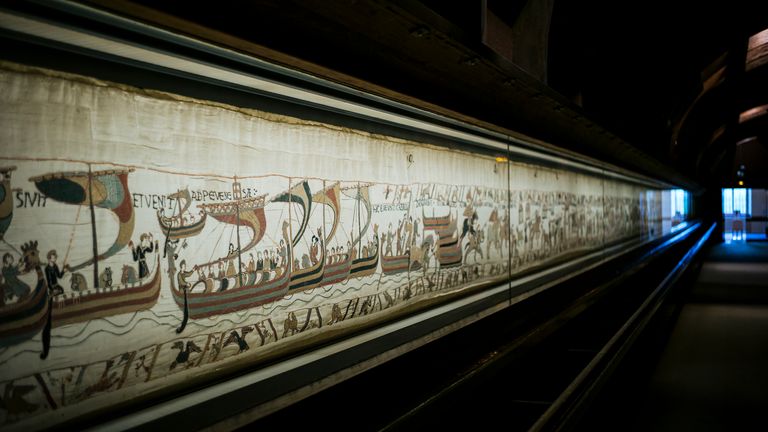
The 11th century tapestry chronicles the Norman conquest of England. Pic: AP
‘You don’t play with this kind of masterpiece’
From 2005 to 2010, Isabelle Attard was the director of the Bayeux Tapestry Museum in France. A former Green party deputy in the French National Assembly, she feels French President Emmanuel Macron’s decision to loan the masterpiece is a “joke”.
“I am not sure that everybody understands how fragile the tapestry is,” she says. “Emmanuel Macron [has] never cared about the advice and the opinion of the people who specialise in textile preservation.
“You just don’t play with this kind of masterpiece because it’s not replaceable. What surprised me is that curators in the British Museum can just see [the tapestry] like a normal item. It’s not the case.”
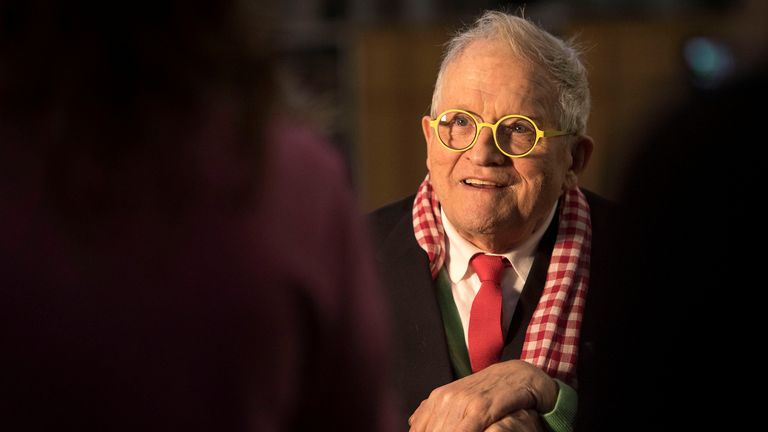
British artist David Hockney is among those criticising the move. Pic: Reuters
Attard’s sentiment is shared by renowned British artist David Hockney who, in an an op-ed for The Independent, said that “some things are too precious to take a risk with”, and warned moving it could cause “fibre contraction or expansion or colour fading”, all for “the vanity of a museum”.
The British Museum has repeatedly insisted it is experienced at moving precious artefacts internationally and that it isn’t taking the fragility of the tapestry for granted.
“A museum’s primary concern is to look after objects either in its care or on loan and we send around 3,000 objects every year,” says Cullinan. “We have incredible conservation staff to do this every day.
“Of course, the tapestry is supremely important. There’s a degree of fragility, but the reality is much more fragile things travel all the time.”
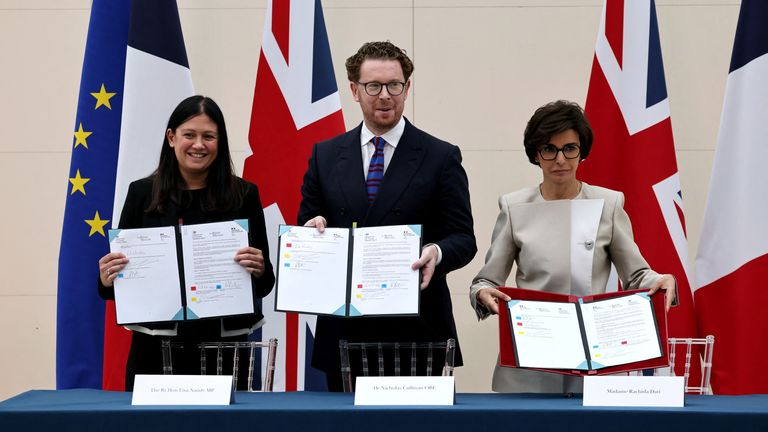
Culture Secretary Lisa Nandy, British Museum director Nicholas Cullinan and France’s culture minister Rachida Dati show the loan agreement in July 2025. Pic: Reuters
Secret ‘dummy runs’ to test route
For security reasons, the museum cannot say when the tapestry is being transported to London. We do know that it’s being driven over on a lorry, going by road and rail, with secret “dummy runs” of the route taking place.
And it has already been moved a short distance. When its official home in Bayeux closed for refurbishment last September, 80 people helped concertina it up, moving it first on to rails before it was covered with cotton wrapping and put into a storage box.
While great care will be taken, not everyone is convinced that the move is worth the risk. More than 77,000 people have signed a French petition calling it a crime against their heritage.
In Bayeux, while some locals were in favour of it at least going on show again somewhere, others told us they were worried.
“It’s a disgrace… there’s no reason to let them have it,” one man from the town, called Joel, told us. “We don’t know what condition it’ll be returned in.”
Julie, a younger cafe worker, says it feels “frustrating”, and that “when you read the specialists’ studies, they mostly say it’s not in a condition to travel right now”.
Is the risk worth the reward?
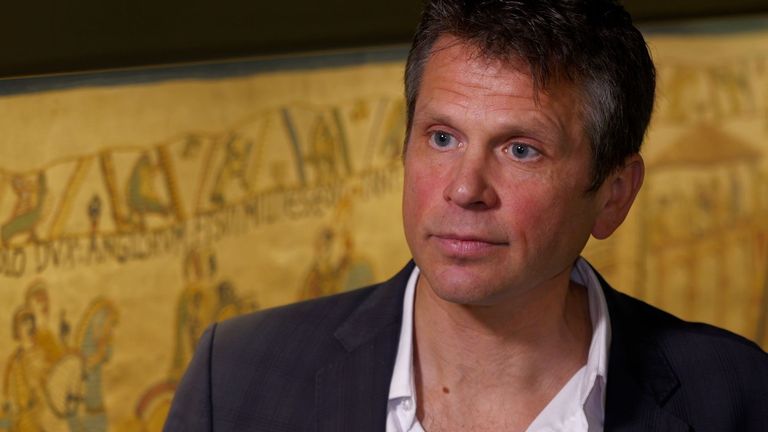
Bayeux Tapestry expert Dr David Musgrove says the move has garnered interest in the artefact
But Dr David Musgrove, author of The Story of the Bayeux Tapestry: Unravelling The Norman Conquest, says it is “a question of risk and reward”.
He concedes that the item is fragile, but says: “The reward is that actually it gives it a long-term survival boost because it means everyone is going to be aware of it. It’s giving it massive media attention.”
Chancellor Rachel Reeves has agreed to sign off on indemnity paperwork which effectively means British taxpayers will stump up anything up to £800m should anything go wrong with the move.
As a former chancellor himself, Osborne says this is standard practice.
“I’m really grateful to the government… and Rachel Reeves for signing the indemnity on behalf of everyone,” he says. “It’s the taxpayer who stands behind this, but that’s not unusual.”
Lord Peter Ricketts, envoy for the Bayeux Tapestry loan, firmly believes the move is a cause for celebration.
“Rightly the French are very concerned to make sure that it comes over here and it goes back, and we’ve promised it will go back in the same condition it arrived,” he says.
“I think after Brexit, Macron was looking for a way to really remind people that UK-French relations are important and they go deep into the culture of both countries.”
And… what about the Elgin Marbles?
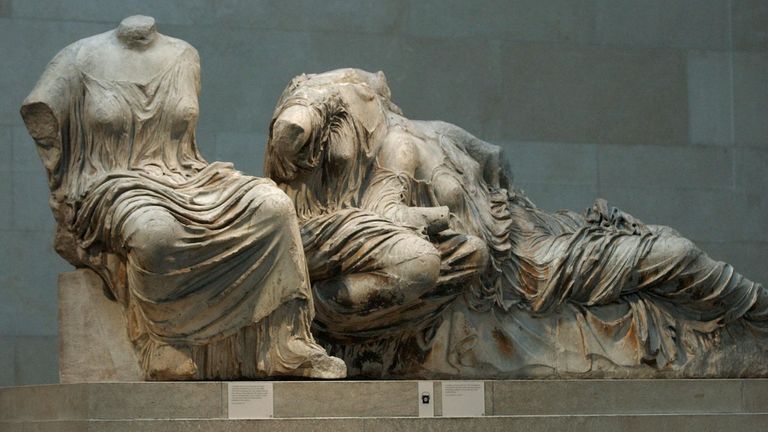
A section of the Elgin Marbles at the British Museum
While the British Museum is understandably delighted to accept the loan on behalf of the UK, a handful of countries, such as Greece, will also be watching what’s happening rather closely.
Could such a loan pave the way for the Parthenon sculptures, also known as the Elgin Marbles, to return home to Greece?
“I’m engaged with the Greek government,” Osborne says. “I would love there to be, an exchange. It’s hard to get everything right and hard to get everything aligned, but I’m really working hard to try and pull it off.”
The Bayeux Tapestry will open in early September, with general admission tickets on sale from 1 July.