Why Nancy Guthrie’s doorbell footage has led to privacy concerns | US News
Doorbell footage showing a masked man approaching Nancy Guthrie’s home on the day of her disappearance has been released by the FBI.
It comes almost 10 days after the 84-year-old mother of TV host Savannah Guthrie went missing – and after local authorities said there was no available footage from the incident.
The retrieval of the video, which sees the suspect at the front door of Ms Guthrie’s home near Tucson, Arizona, holding a gun, has been a welcome development in the case.
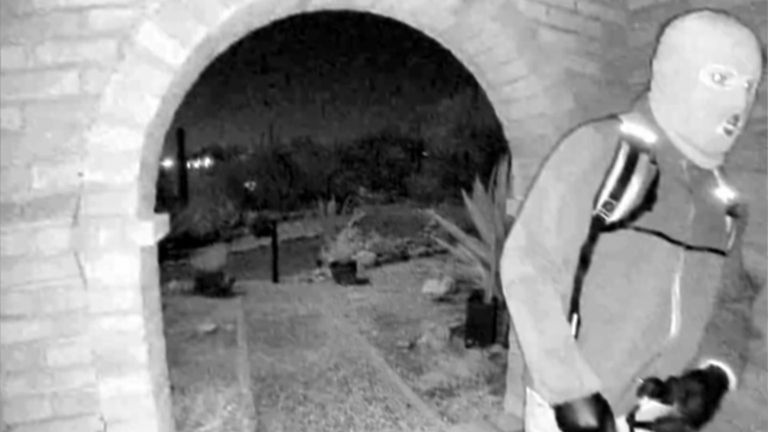
FBI releases new images in the search for Nancy Guthrie. Pic: FBI
Yet some have raised concerns about what the footage’s existence says about our rights to privacy.
Here’s what you need to know about how the footage was retrieved and why it has proved controversial.
Video collected via ‘backend systems’, FBI says
Ms Guthrie, who lives alone, has a Nest camera on her front door.
Days ago, Pima County Sheriff Chris Nanos said Ms Guthrie’s camera was disconnected just before 2am on the night she disappeared – 1 February – and that despite the camera’s software detecting movement minutes later, no footage was preserved.
He didn’t explain how the camera was disconnected.
He also said the resident didn’t have a subscription with Nest, which would have meant footage was automatically saved.
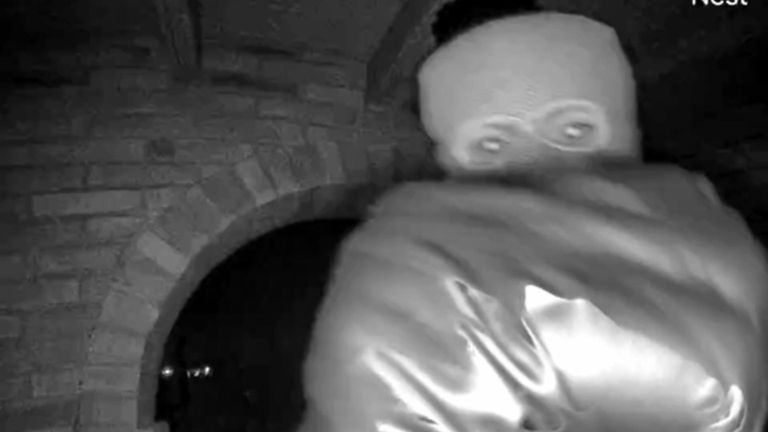
FBI releases new images in the search for Nancy Guthrie. Pic: FBI
Sheriff Nanos did say that investigators were still trying to work with a tech company on the difficult forensic task of recovering any video from the property, where Ms Guthrie had multiple cameras.
Then on 10 February, FBI director Kash Patel said footage had been recovered via “backend systems”.
Sharing video and pictures of the suspect on Ms Guthrie’s door, Mr Patel wrote on X: “Over the last eight days, the FBI and Pima County Sheriff’s Department have been working closely with our private sector partners to continue to recover any images or video footage from Nancy Guthrie’s home that may have been lost, corrupted, or inaccessible due to a variety of factors – including the removal of recording devices.
“The video was recovered from residual data located in backend systems.”

Nancy Guthrie’s home in Tucson, Arizona on 7 February, a week after she was last seen. Pic: AP
Mr Patel did not say how the FBI was able to collect the video, or why it took so long to retrieve.
Joseph Giacalone, a retired New York police sergeant who managed hundreds of homicide and missing person cases, suggested the FBI may have intentionally delayed the footage’s release and tried to identify the person themselves.
“You’re trying to keep these things close to the vest. I think they worked this angle for a couple of days,” he said.
Nancy Guthrie disappearance latest
Former FBI cybercrime agent E.J. Hilbert told Sky News’s US sister network NBC News that it can be challenging for Google to find recordings and that it takes time for legal processes to play out.
“Nest/Google deletes billions of data points every hour,” he said, comparing the process to finding a needle in a haystack.
Why has this led to privacy concerns?
Google’s Nest offers two tiers with its subscription service: Standard, which tracks “event-based history” on a rolling 30-day basis, and Advanced, a subscription which allows for video to be recorded 24/7 and stores the contents for 10 days, with event-based storage for 60 days.
“Events” refer to movement near the camera.
The video recorded on home camera devices is then routinely transmitted to data centres because the devices themselves don’t have capacity to store it.
But Ms Guthrie didn’t have a subscription according to officials, and her device was disconnected, which has led some experts to question why Google was able to collect, access and share footage collected on the camera.
Michelle Dahl, the executive director at the Surveillance Technology Oversight Project, said: “Our hearts are on her [Ms Guthrie’s] family and what they are going through, and we are glad for any information that can lead to her being found.”
At the same time, she added, “we should absolutely be alarmed over the privacy implications that are at stake with this video that was recovered by the Nest camera”.
Google’s privacy policy does make clear that videos can be captured when a device is offline.
“That means you may not see a visual indicator when your camera is sending the video footage to our servers,” the policy states.
The policy also says while footage can stay on cloud servers for varying amounts of time, users have the right to view and delete them at their discretion.
Nancy Guthrie’s home in Tucson, Arizona on 7 February, a week after she was last seen. Pic: AP
Stacey Higginbotham, a policy fellow at Consumer Reports who specialises in cybersecurity issues, says Google routinely purges footage rather than retaining it permanently, but adds that videos can still be retrieved and watched before being wiped.
“It’s basically like when you send an email to the trash. It’s still accessible,” she says.
When can Google share home videos?
The uptake in internet-connected cameras at home has been a big pro for law enforcement, with authorities regularly working with companies to recover video footage relevant to cases.
Experts say that how compliant companies like Google are when it comes to investigation requests depends on their policies.
Ms Dahl says that under many user agreements, camera companies need a warrant or consent from the camera owner to share footage with law enforcement, but adds there are plenty of legal loopholes that allow the companies to bypass these steps.
She adds that some companies have user agreements specifying that the data collected on cameras belong to the camera company, not the private camera owner, meaning they can share footage with law enforcement at their own discretion, without even notifying its users.
“I think the public has gotten too comfortable with surveillance cameras in not only public spaces, but also their private homes, without thinking about the consequences of where that data ends up,” she says. “If a camera is absolutely necessary for your security, look into options where that data is not transmitted off to a cloud.”
In a transparency report, Google’s Nest said that it does work with law enforcement but that it also works to maintain user privacy and notifies users about legal demands.
“For example, if a US government agency presented us with a search warrant to investigate a crime they think was captured on a Nest Cam, we wouldn’t just hand over user data. We’d analyse the request to be sure the warrant wasn’t overly broad, then we’d make sure the information they requested was within the scope of the warrant,” the company wrote.
Sky News has contacted Nest’s parent company Google for comment.
The company previously told NBC News that it was assisting with the Guthrie investigation and that it could not provide further details.