NASA’s Hubble Space Telescope discovers ‘Dracula Disk’, 40 times bigger than solar system
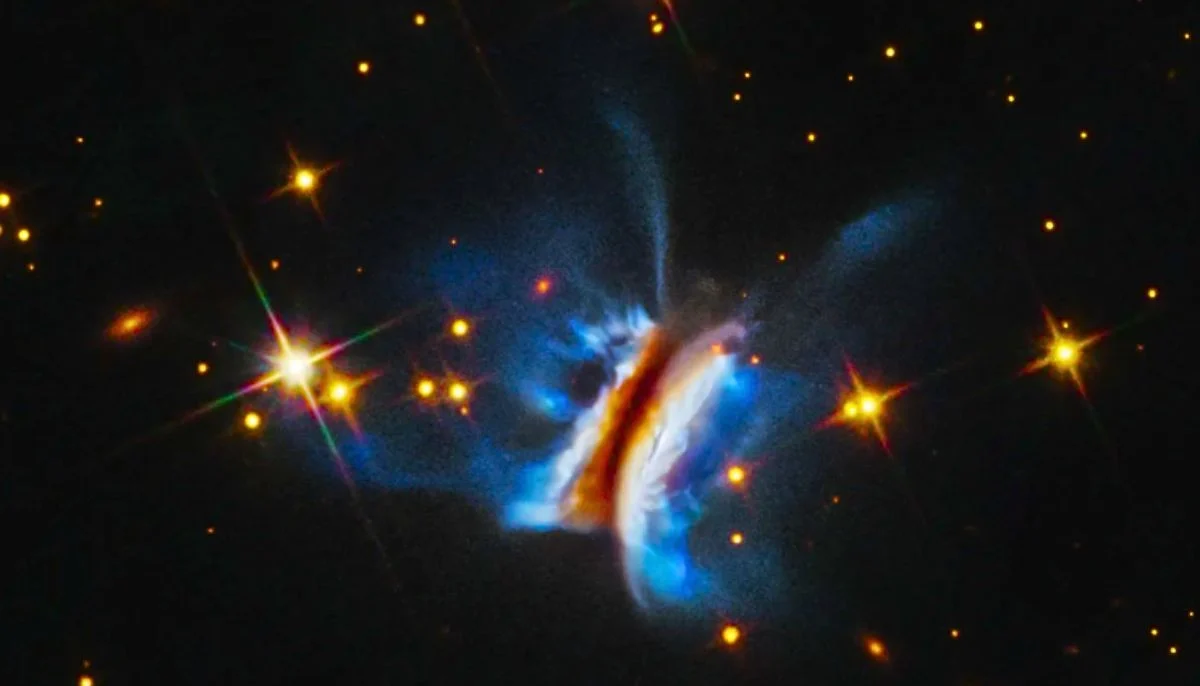
In the latest scientific discovery, the Hubble Space Telescope shocks space enthusiasts by revealing an unusual object that is about 40 times larger than the whole solar system itself.
The latest observations reveal a giant, turbulent planet-forming disk that may reshape theories of how planetary systems develop.
Astronomers working with NASA’s Hubble Space Telescope have captured images of the “largest protoplanetary disk” ever seen surrounding a young star.
Observed in visible light for the first time, the disk appears far more turbulent and disordered than expected, with streamers of material extending much higher above and below the disk than in any comparable system.
The surprising fact reveals that it is even more unusual; the longest filaments appear on only one side of the disk.
This peculiar, lopsided structure suggests that dynamic processes, like the recent infall of dust and gas, or interactions with its surroundings, are shaping the disk.
The results, published in The Astrophysical Journal, represent a major achievement for Hubble and offer new insight into how planets might form under extreme conditions, advancing NASA’s broader effort to explore the universe and our place within it.
A planet-forming disk of unprecedented scale:
The object, known as IRAS 23077+6707 and nicknamed “Dracula’s Chivito,” lies about 1,000 light-years from Earth and stretches nearly 400 billion miles across.
This makes it roughly 40 times wider than the span of our solar system out to the Kuiper Belt of icy bodies.
The disk is so large and dense that it blocks the view of the young star at its center, which astronomers think could be a single hot, massive star or a close pair of stars.
Moreover, its sheer size already sets it apart, but its structure suggests it may also be one of the strangest planet-forming disks yet identified.
This peculiar lopsided structure suggests that dynamic processes, like the recent infall of dust and gas, or interactions with its surroundings, are shaping the disk.
“We were stunned to see how asymmetric this disk is,” said co-investigator Joshua Bennett Lovell, also an astronomer at the CfA. “Hubble has given us a front-row seat to the chaotic processes that are shaping disks as they build new planets—processes that we don’t yet fully understand but can now study in a whole new way.”
The research was shared from “Hubble Reveals Complex Multiscale Structure in the Edge-on Protoplanetary Disk IRAS23077+6707.”