Sex offences against women not given same response as other high-priority crimes, inquiry finds | UK News
Sexually motivated crimes against women in public are not afforded the same response as other high-priority crimes, an inquiry into the rape and murder of Sarah Everard by off-duty police officer Wayne Couzens has found.
Publishing her findings on Tuesday, Lady Elish Angiolini, a former solicitor general for Scotland, said: “There is no better time to act than now. I want leaders to, quite simply, get a move on. There are lives at stake.”
The second part of the independent inquiry is split into two reports, with the first focusing on the prevention of sexually motivated crimes against women in public spaces.
Despite violence against women and girls being described as a “national threat” in the 2023 strategic policing requirement and it being mentioned as a high priority for the current government, Lady Elish found the “response overall lacks what is afforded to other high-priority crimes”.
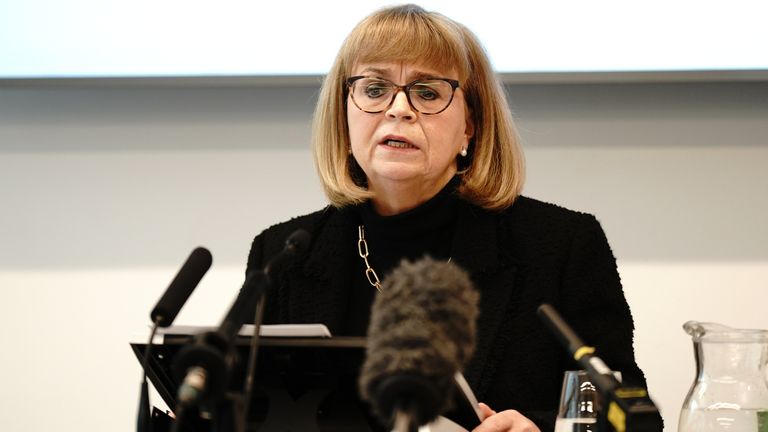
Lady Elish Angiolini makes a statement after the first report from the inquiry is published. Pic: PA
She said her recommendation in the first part of the inquiry, that those with convictions and/or cautions for sexual offences should be barred from policing, has not yet been implemented.
Additionally, 26% of police forces have yet to implement basic policies for investigating sexual offences, including indecent exposure.
Lady Elish said: “Prevention in this space remains just words. Until this disparity is addressed, violence against women and girls cannot credibly be called a ‘national priority’.”
‘Women deserve to feel safer’
The inquiry chair said with a greater spotlight on the safety of women in public, women should feel safer – “but many do not”.
“Women change their travel plans, their routines, and their lives out of fears for their safety in public, while far too many perpetrators continue to roam freely,” Lady Elish said after her report was published.
“Women deserve to feel safer. They deserve to be safer.”
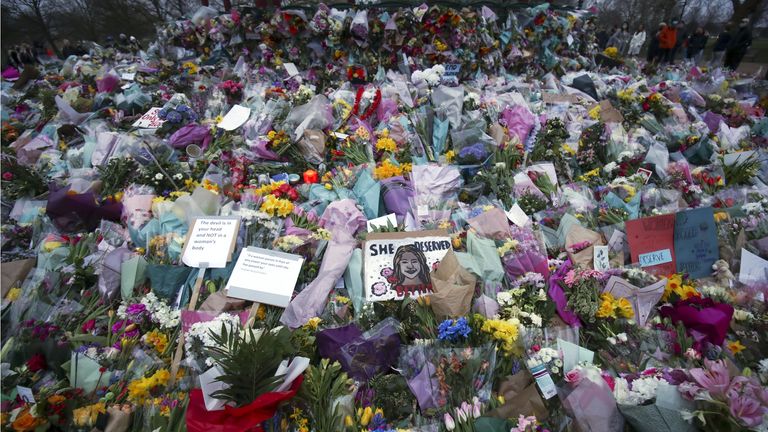
Floral tributes and a drawing of Sarah Everard were left at the Bandstand on Clapham Common, London. Pic: PA
The report found that there was a lack of data on sexually motivated crimes against women in public spaces, with Lady Elish calling it a “critical failure”.
In the inquiry’s public survey of 2,000 people, 76% of women aged 18 to 24 reported feeling unsafe in public because of the actions or behaviour of a man or men.
A similar study for UN Women UK in 2021 found that 71% of women in the UK had experienced some form of sexual harassment in public, with higher rates of 86% for younger women aged 18 to 24.
Lady Elish said prevention was most effective when it focuses on the perpetrators, “yet too many opportunities to apprehend violent perpetrators have not been acted upon”.
“Too many perpetrators are slipping through the cracks in an overworked system; police, prison and probation resources are overstretched and under-funded.”
‘No silver bullet’
She said sexually motivated crimes against women in public spaces are a whole society issue that requires a whole society response, involving government, police and other agencies working together to fix an “unacceptable” and “deeply disappointing” level of inconsistency in responses.
Recognising sexually motivated crime against women as a public health matter as well as a criminal matter was crucial, as these crimes were “not inevitable”.
The inquiry considers that “there is not one silver bullet” in tackling these crimes, instead calling for a “long-term commitment, cross-party agreement and a steady course in preventing these crimes – through education, thorough investigations and swift arrests – always with an unswerving focus on the perpetrators”.
Lady Elish’s 13 recommendations include:
• Focus on better collection and sharing of data at a national level
• Better and more consistent targeted messaging around the issues, which is to be managed centrally
• An information and intervention programme for men and boys – to be coordinated between the departments of education and social care as well as the Home Office – to create a culture of positive masculinity
• Improving the investigation of sexually motivated crimes against women and girls – recommending that the home secretary mandates police forces to follow particular procedures
The first part of the inquiry, published in February 2024, investigated how former armed Metropolitan Police officer Couzens was able to abduct, rape and murder Ms Everard on 3 March 2021.
He had used his status as a police officer to trick Ms Everard, a 33-year-old marketing executive, into thinking he could arrest her for breaking lockdown rules, as she walked home from a friend’s house in south London.
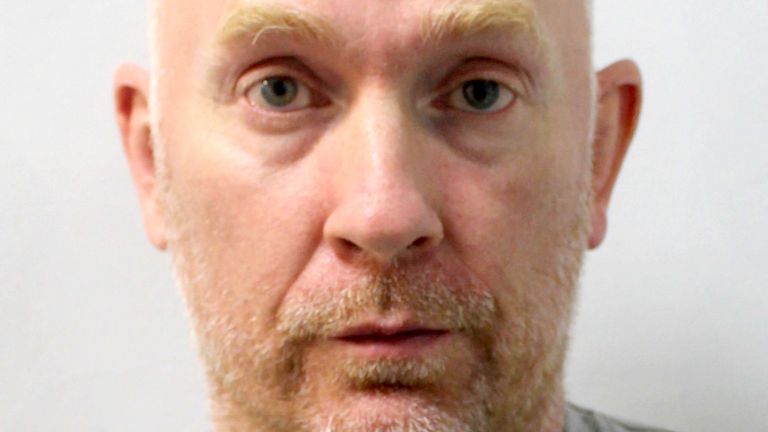
Wayne Couzens. Pic: PA
The report found Couzens should never have been a police officer, stressing there needs to be a “radical overhaul” of police recruitment to stop “another Couzens operating in plain sight”.
It examined Couzens’ career and highlighted how major red flags about him were “repeatedly ignored” by police vetting and investigations.
After the publication of the second report, Ms Everard’s family said in a statement that the report “shows how much work there is to do in preventing sexually motivated crimes against women in public spaces”.
They added: “Sarah is always in our thoughts, of course, and we feel the inquiry continues to honour her memory.
“So too does it speak for all women who have been the victim of sexually motivated crimes in a public space and all those at risk.
“We stand with them in recognising the urgent need for positive change and in expectation of a better future.”
Read more:
Women still feel unsafe on Britain’s streets
How Sarah Everard’s killer was caught
Timeline: Wayne Couzen’s behaviour and crimes
The second report of Part 2 of the inquiry will investigate police culture in regards to misogynistic and predatory attitudes and behaviours.
Following the sentencing of former police officer David Carrick in February 2023, Part 3 of the inquiry was established to examine Carrick’s career and conduct.
This breaking news story is being updated and more details will be published shortly.
Please refresh the page for the fullest version.
You can receive breaking news alerts on a smartphone or tablet via the Sky News app. You can also follow us on WhatsApp and subscribe to our YouTube channel to keep up with the latest news.