From floppy disks to fax machines, many once-common office technologies would be baffling to the younger generation.
Now, a study suggests that the humble keyboard could be the next device to vanish when Gen Alpha enters the workforce.
According to researchers from the London School of Economics (LSE) and Jabra, the next generation of workers won’t ever need to write out an email by hand.
Instead, these youngsters will rely on voice notes to communicate with their bosses.
The report, led by Professor Michael Muthukrishna of LSE, predicts that this change will be coming sooner than most people expect.
By 2028, the report predicts that voice technology will be the default mode of working for everyone.
Professor Muthukrishna and his co-authors conclude: ‘This isn’t the distant future. This is the next generation of how we will interact with Generative AI.
‘It’s powered by voice, and it’s coming sooner than we think.

Gen Alpha won’t ever need to use a keyboard when they enter the workforce, according to a new report. Instead, youngsters will just send voice messages in the office (stock image)
The study blames the rapid rise of voice technology on the growing importance of AI tools in the workplace.
That means people will be much more likely to use voice transcription and dictation software to write reports and messages.
Researchers predict that, within the next three years, keyboards will only be used for tweaking and editing.
People will work by thinking aloud to a series of AI tools that will organise their ideas, take notes, and carry out tasks on their behalf.
The oldest members of Gen Alpha, born after 2010, will start entering the workforce around 2030.
That means most of this cohort will never know what it is like to work in an office where typing is the default.
Paul Sephton, global head of brand communications at Jabra, told Fortune: ‘By the time Gen Alpha enters the workforce, AI will be fully embedded, and their work will be spoken long before it’s ever typed.’
Mr Sephton explains: ‘They’ll talk to write, then type to refine.

Researchers predict that the keyboard will be obsolete by 2028 as workers adopt voice tools such as AI-powered dictation apps for the majority of their tasks (stock image)
‘And they’ll direct work, not just draft it. Typing becomes editing, not thinking. The first draft of the future is spoken.’
According to researchers, the biggest driver behind this change is the fact that people find it easier and more convenient to operate AI tools by speaking, rather than typing.
Currently, 14 per cent of people surveyed said they preferred speaking to typing when using AI tools.
But it won’t just be the youngest workers who abandon the keyboard, as researchers found that older workers were actually more keen to use voice technology than their Gen Z co-workers.
However, the death of the keyboard may come with some major drawbacks.
The report notes that people who used voice controls performed 20 per cent worse than those who typed on certain tasks.
The researchers attribute this to the ‘challenge of articulating complex thoughts aloud’.
Additionally, workers who spoke with the researchers expressed concerns that needing to speak aloud to work created privacy and data-security risks.
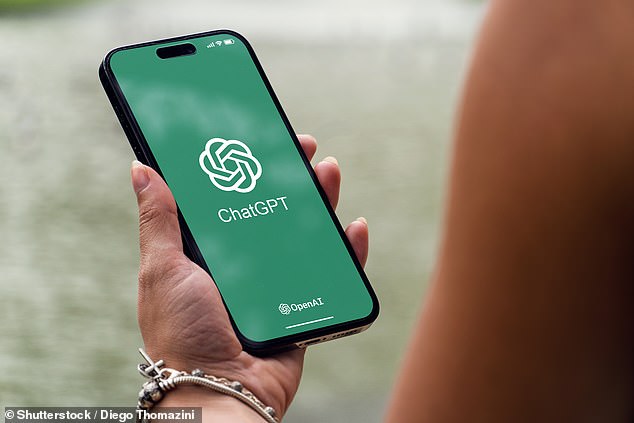
Researchers blame this change on the rise of AI tools, such as ChatGPT, which are often easier to operate via voice controls than by typing
One participant complained: ‘If I’m at work in an open-plan office and using AI tools, I don’t want to be speaking out loud. I’d rather just type — because when speaking, others can hear and so I’m more conscious of what I’m saying.’
Others worried about giving their voice information to the AI companies behind these tools, which often use user data to train their models.
Even if voice notes might be more convenient to send, experts also have concerns about how useful they might be in an office environment.
For example, it is much easier to read a message written out in text than it is to listen to an audio recording.
Professor Fabrice Cavarretta, of the ESSEC Business School, told Fortune: ‘Scanning an email beats playing a voice message.’
Likewise, written text is easier to reference back to and check on at a later date due to its ‘set in stone’ nature.
However, even if the written word doesn’t disappear from the office entirely, keyboards and typing still might.
Mr Cavarretta adds: ‘My anticipation is that voice will increasingly serve as an input method but be systematically transcribed into text within organizations using AI tools.’