HMRC disaster as 30% of Britons pay ZERO income tax due to ‘a decade of policy’
An estimated 30 per cent of adults across the UK, approximately 16 to 17 million people, do not contribute to income tax, according to analysis of HM Revenue and Customs (HMRC) figures.
HMRC projections indicate that around 39.1 million people will pay income tax during the 2025-26 tax year, while Office for National Statistics (ONS) figures place the total adult population at between 55 and 56 million.
The primary explanation for this gap lies in the £12,570 personal allowance, which permits individuals to earn up to that sum annually before any income tax applies.
This threshold effectively shields millions of lower earners from the tax system entirely. Those who fall beneath this income threshold include a diverse range of individuals.
Britain’s tax system is being blamed on a ‘decade of policy’
|
GETTY
Roughly 4.5 per cent of UK adults are unemployed, while approximately five per cent earn minimum wage. Around 2.75 per cent are pensioners whose sole income derives from the state pension.
Students represent another significant group outside the tax net, alongside part-time workers and carers whose earnings remain modest.
Some individuals receive their income primarily through benefits or other non-taxable sources, meaning they form part of the adult population without ever encountering income tax obligations.
Despite these figures, the proportion of non-taxpayers has actually shrunk in recent decades as frozen thresholds have drawn more earners into the system.
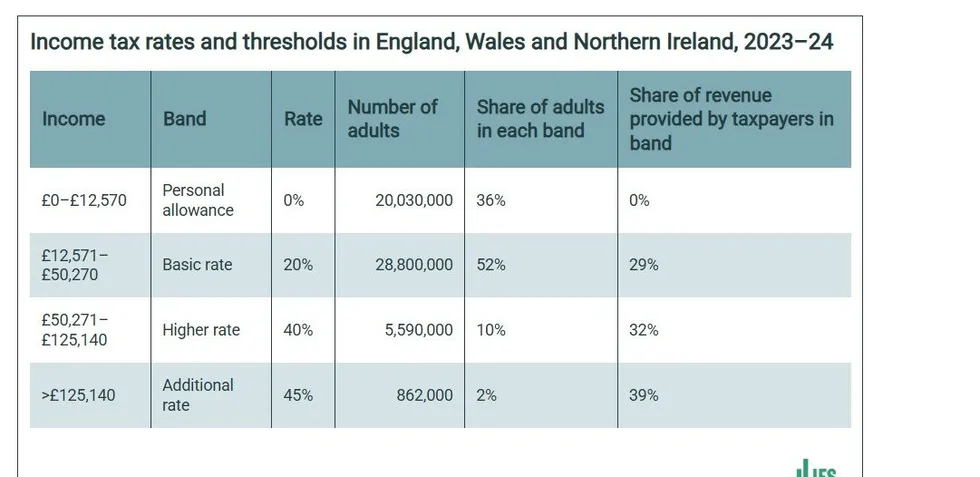 How much are you paying in income tax? | IFS
Some one per cent of Britons are paying 30 per cent of Britain’s taxes
|
GETTYArjun Kumar, a qualified accountant and founder of Taxd.co.uk, cited that more than half of the population, 53.3 per cent, lived in households that received more in state support than they contributed through taxation during the 2024 financial year.
This leaves fewer than half of households, just 46.7 per cent, effectively funding public services. Britain’s top one per cent of earners now shoulder nearly 30 per cent of all income tax collected.
This dependency on a small fraction of taxpayers creates what experts describe as a precarious narrowing of the tax base.
Mr Kumar explained: “The fact that roughly a third of UK adults do not pay income tax is often used as a political lightning rod, but it is a direct result of a decade of policy.
 Chart shows number of over 60s set to be pulled into higher or additional rate income tax brackets between 2023/24 and 2027/28. Figures are rounded. | GB NEWS
“By maintaining a personal allowance of £12,570, the Government has protected the subsistence income of the lowest earners, but it has also created a precarious narrowing of the tax base.
“This makes the Treasury incredibly sensitive to the movement of high-potential individuals. When these people choose to leave the UK or reduce their hours to avoid tax traps, like the 60 per cent effective rate, the country collectively loses out on high-growth opportunities.
“The real story isn’t just about who isn’t paying; it’s the growing chasm between those outside the net and the squeezed middle who are being dragged into higher brackets by frozen thresholds.
“To make the UK resilient, we need to move away from stealth taxes like fiscal drag and focus on reform that ensures the burden doesn’t fall on a shrinking pool of earners. We need to give people a reason to stay and grow their wealth here, rather than incentivising them to leave.”