Oil price surges may ruin Rachel Reeves inflation targets and Bank of England interest rate hopes
Escalating military confrontation involving Iran has cast fresh doubt over UK interest rate expectations after oil prices jumped nearly 13 per cent in early trading.
Brent Crude climbed to its highest level in more than a year as tensions intensified in one of the world’s most critical oil production and shipping regions.
Iran has reportedly blocked passage through the Strait of Hormuz, the strategic waterway linking the Persian Gulf to global energy markets.
The chokepoint accounts for approximately one fifth of all seaborne oil and gas shipments worldwide.
Two vessels were struck near the Hormuz shipping lane, according to officials at the UK Maritime Trade Operations centre.
The disruption follows US and Israeli strikes on Iranian targets on Sunday amid an intensifying regional campaign.
Susannah Streeter, chief investment strategist at Wealth Club, said the shipping blockade would have direct consequences for British households.
She said: “The effective closure of the Strait constrains crucial supplies from the Gulf, which is why prices have risen so sharply.”
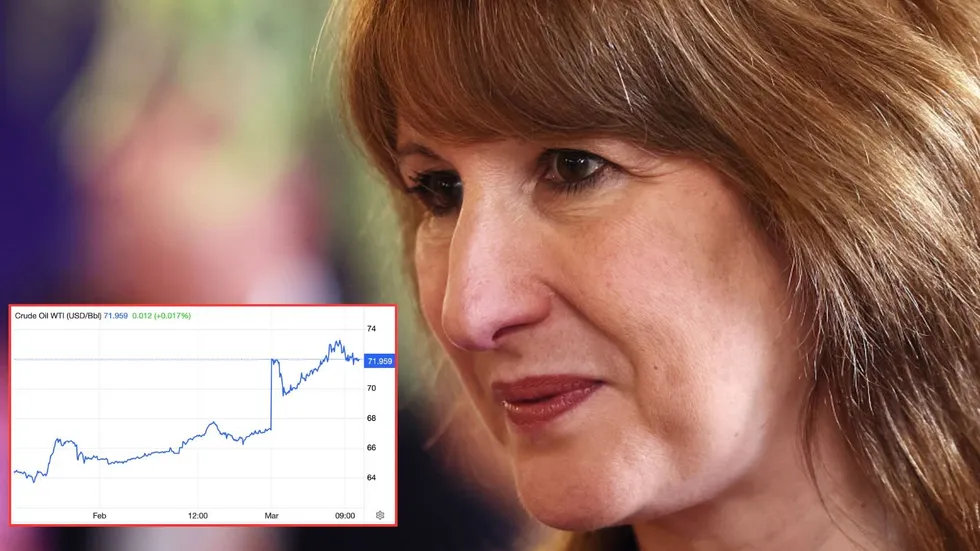
Oil prices have skyrocketed amid supply chain disruption
|
GETTY/Trading Economics
Ms Streeter added: “It will come as a blow to households, who will see prices at the pumps rise significantly.”
She warned the renewed surge in energy costs could complicate monetary policy decisions in the UK.
“It also adds another layer of uncertainty over future interest rate cuts, given that higher fuel prices will put upward pressure on headline inflation.”
The Bank of England may now delay reducing borrowing costs while assessing the economic fallout from the escalating conflict.
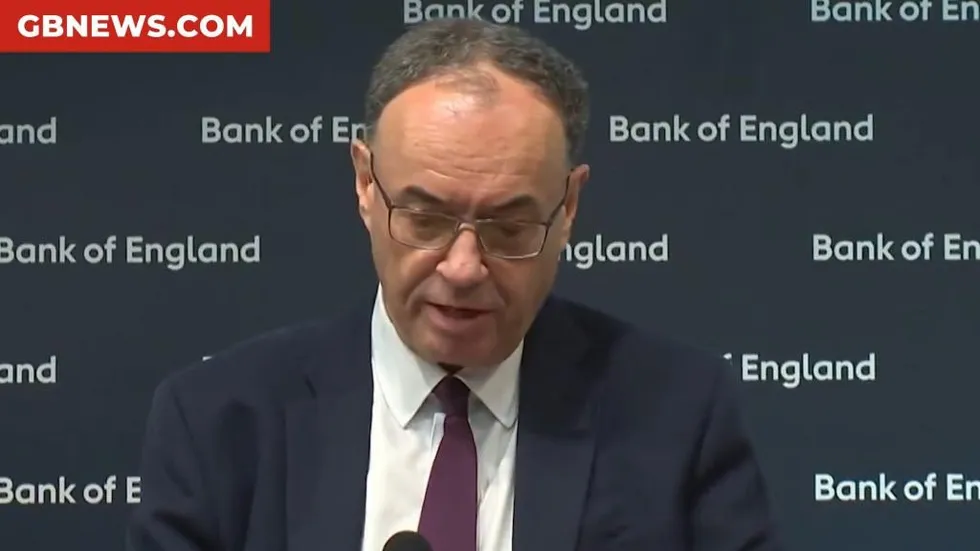
Andrew Bailey had hopes of inflation falling to the two per cent target by spring
|
BANK OF ENGLAND / GB NEWSLondon’s FTSE 100 fell more than one per cent at the open before recovering some losses as trading progressed.
Sterling weakened against the dollar, falling 0.92 per cent to 1.335, its lowest level since December, as investors moved towards the US currency.
Travel stocks were among the heaviest fallers in early trading.
Carnival Corporation dropped eight per cent, while International Airlines Group fell 7.6 per cent.
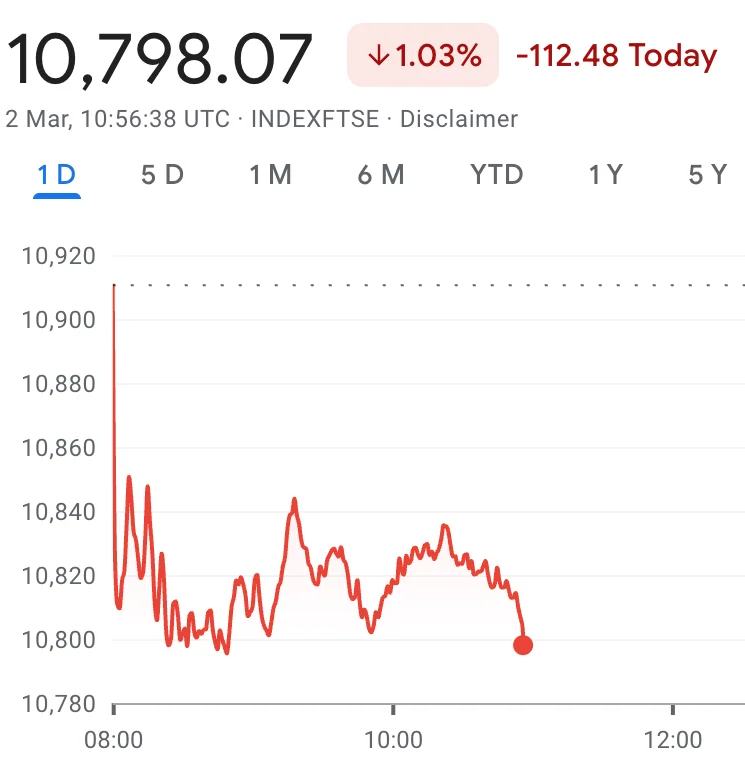
The Ftse continues to tumble
|
Google finance
Wizz Air, which operates routes to Dubai and Abu Dhabi, declined 7.3 per cent, with retailers SSP Group and WH Smith also trading lower.
Defence contractor BAE Systems rose 7.4 per cent to 2,268p, diverging from the broader market trend.
Oil majors benefited from the price increase, with Shell gaining 4.5 per cent and BP rising 3.5 per cent.
In Asia, Japan’s Nikkei 225 closed down 1.5 per cent as markets reacted to developments in the Middle East.
Before the escalation, financial markets had priced in a 75 per cent probability that the Bank of England would cut rates to 3.5 per cent this month.
A further reduction to 3.25 per cent had been widely anticipated by September.
Recent inflation data and falling energy bills had previously pointed towards a marked slowdown in price growth from April.
However, sustained increases in fossil fuel costs could alter that trajectory if higher oil and gas prices feed through to consumer bills.
Any prolonged elevation in energy costs would be likely to influence the expected path for both inflation and interest rates in the months ahead.