Professor who forced pause of puberty blocker trial withdraws amid ‘bias’ concerns
A professor who forced the pause of a puberty blocker trial has withdrawn from any further involvement in the study following accusations of “bias”.
Professor Jacob George, who became chief medical and scientific officer at the Medicines and Healthcare products Regulatory Agency (MHRA) in January, raised fresh objections to the Pathways clinical trial in February.
His intervention prompted the Department of Health to pause the £10.7million study, which was preparing to recruit children only weeks later.
The decision has since triggered mounting concern among scientists, clinicians and lawyers, who argue that Professor George’s actions were flawed and based on misunderstandings of clinical trials and medical law.
Critics noted that the intervention came five months after MHRA officials had already approved the trial and more than a month after recruitment was due to begin.
It has now emerged that Professor George, a cardiovascular medicine academic at the University of Dundee, previously published social media posts suggesting strongly gender-critical views.
In posts later deleted, he criticised what he called the “well-meaning idiocy” of NHS staff who rejected the idea that sex is fixed at birth.
He also praised JK Rowling as a “treasure of our time” after she welcomed a Supreme Court ruling that the legal definition of a woman should be based on biological sex.

Professor Jacob George has stepped away from the trials
|
UNIVERSITY OF DUNDEE
In another post, he said “the denial of basic biological fact is concerning” after tests confirmed that Algerian Olympic boxer Imane Khelif was female, the Times reports.
An MHRA spokeswoman said: “Following the identification of social media posts made prior to his appointment, Professor Jacob George is recused from further involvement on the Pathways clinical trial as a precaution.”
Dr Max Davie, a consultant paediatrician who previously worked at the NHS Children and Young People’s Gender Service, said the posts raised serious questions.
He said: “The tweets by Professor George give a clear indication of his personal views on the topic.
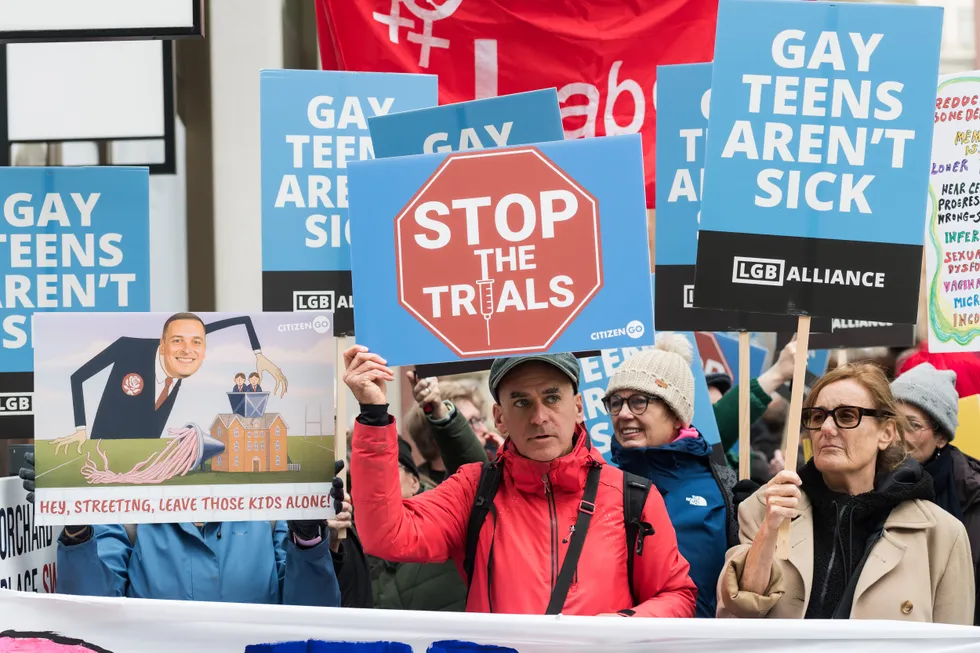
Protesters gathered outside the Department of Health and Social Care against the puberty blocker trial on December 17 last year
|
GETTY
“He is quite at liberty to hold whatever views on gender identity he may, but what he cannot do is allow these views to affect the fulfilment of his public duty.”
The consultant paediatrician added: “To be clear, there is no compelling scientific reason to halt the Pathways trial.
“While Professor George’s personal convictions are not the only possible explanation for the MHRA’s abrupt volte-face, it is the only one for which we have evidence.”
The Pathways trial was commissioned following recommendations by Baroness Cass, author of a landmark review into NHS gender services that led to the closure of the Gender Identity Development Service at the Tavistock clinic in north London.
Baroness Cass concluded there was insufficient evidence that puberty blockers benefitted children with gender incongruence and called for a rigorous clinical trial to assess their effects.
She later described the MHRA’s intervention as “completely bizarre” and said it appeared to be driven by politics rather than science.
In an interview last week, the Baroness said: “There are no new research findings and the MHRA hasn’t presented any new evidence.”
Professor George wrote to trial leaders at King’s College London on February 13 raising concerns about participant age, suggesting children as young as ten could be included.
One scientist involved said most participants would already have entered puberty by 14 and warned that excluding younger children would render the trial unethical and pointless.
Professor George also raised concerns about “Gillick competence”, a legal test of whether under-16s can consent to medical treatment.
Sir Jonathan Montgomery, professor of healthcare law at University College London, said Gillick competence does not apply to clinical trials, a point confirmed by the Court of Appeal in the Keira Bell case.
“It reflects badly on the MHRA that they seem not to understand the law governing their work,” he said, warning that limiting children’s rights in trials would weaken safeguards rather than strengthen them.
Despite the backlash, Helen Joyce of the sex-based rights charity Sex Matters defended Professor George, saying his views were “entirely aligned with the mainstream” and calling for his reinstatement.