New mystery about ‘Ring Nebula’ shock astronomers: Here’s why
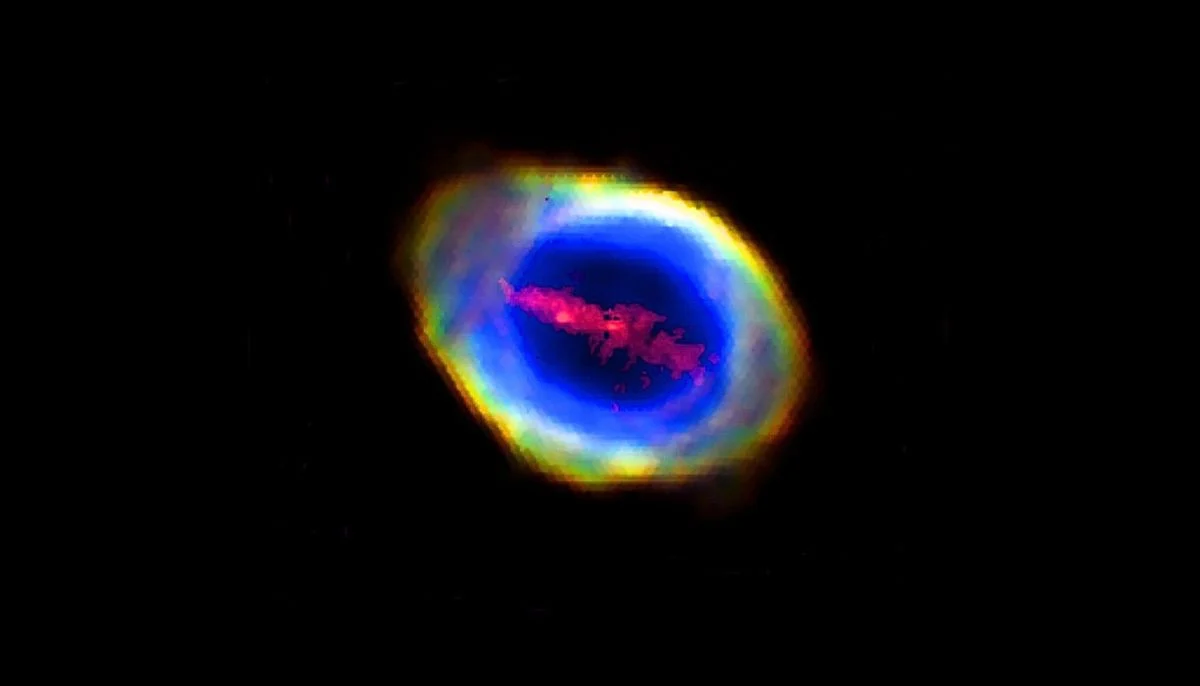
A new mystery about the colorful Ring Nebula has again caught attention in space.
A huge bar of iron has been discovered lurking inside the iconic Ring Nebula.
The structure is enormous, spanning hundreds of times the size of Pluto’s orbit and containing a Mars-sized amount of iron.
Researchers have spotted a large cloud of iron atoms in the shape of a bar from the perspective of Earth; it has the appearance of a ring, although it’s believed that it’s actually more like a cylinder of material that we are seeing end-on.
The iron bar was discovered by a team using the William Herschell Telescope (WHT) located in the Observatorio del Roque de los Muchachos, on La Palma Island, Spain, along with a new instrument called WEAVE (WHT Enhanced Area Velocity Explorer).
About Ring Nebula:
The Ring Nebula, a stunning celestial structure residing in our neighborhood of the Milky Way galaxy.
According to researchers, it’s made up mostly of hydrogen and helium, with small quantities of heavier elements,” Wesson said.
Previously, it was first discovered by French astronomer Charles Messier in 1779 and has been studied extensively ever since.
As per researchers, there are about 3,000 such nebulas known in our galaxy.
Studying them lets astronomers examine the life stage of stars when chemical elements forged by nuclear processes inside them are released into interstellar space to be recycled and contribute to the next generation of stars and planets.
“We look forward to getting more data to follow up on this discovery, to try to unravel this new problem and work out where the iron bar has come from,” Wesson said.ching about 3.7 trillion miles (6 trillion km) long across the face of the nebula, which is a glowing shell of gas and dust expelled by a dying star, and are searching for an explanation.
Also known as Messier, the Ring Nebula is a “planetary nebula.”
It is the glowing remains of what was once a sun-like star, which ran out of fuel for nuclear fusion and shed its outer layers as its core collapsed to form a dense stellar remnant called a white dwarf.
Well, just how this iron bar formed remains a mystery to Wesson and colleagues.
One possibility is that it is related to how the star ejected its outer layers and how this process progressed.
Alternatively, the formation of this arc of iron plasma could be the result of the Ring Nebula’s doomed star vaporizing an orbiting rocky planet as its outer layers puffed out.
“We definitely need to know more—particularly whether any other chemical elements co-exist with the newly detected iron, as this would probably tell us the right class of model to pursue,” team member and UCL astronomer Janet Drew said.
“The discovery of this fascinating, previously unknown structure in a night-sky jewel, beloved by skywatchers across the Northern Hemisphere, demonstrates the amazing capabilities of WEAVE,” Scott Trager, WEAVE Project Scientist based at the University of Groningen, said. “We look forward to many more discoveries from this new instrument.”
That could include discovering if any other planetary nebulas like the Ring Nebula also contain unexpected structures.
“It would be very surprising if the iron bar in the Ring Nebula were unique,” Wesson concluded. “So hopefully, as we observe and analyze more nebulae created in the same way, we will discover more examples of this phenomenon, which will help us to understand where the iron comes from.”
The research was published in the journal Monthly Notices of the Royal Astronomical Society on Thursday, January 15, 2026.