

Gerry Adams has denied being a member of the Irish Republican Army (IRA), telling a court he had “no involvement whatsoever” in bombings carried out by the paramilitary group.
In a witness statement to the Royal Courts of Justice in London on Tuesday, Mr Adams said he was “never a member of the IRA or its Army Council” and denied involvement in any bombings in the UK.
The former leader of Sinn Fein said the allegations brought against him in a civil claim, that he was responsible for three bombings in Britain during the 1970s and 1990s, were “untrue”.
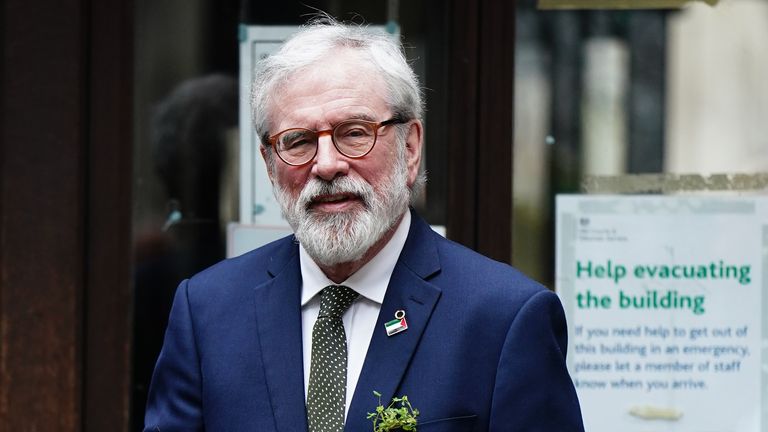
Gerry Adams. Pic: PA
Mr Adams, one of Northern Ireland‘s best-known political figures, has long been accused of having been a member of the Provisional IRA. He has always denied the allegation.
The 77-year-old wished the judge a “very happy St Patrick’s Day” as he entered the witness box.
“I was never the commanding officer, or OC of the 2nd Battalion of the IRA’s Belfast brigade,” Mr Adams said in his 20-page statement.
“Indeed, I have never held any rank or role within the IRA, including on the IRA’s Army Council.
“I have never held a command-and-control role in the IRA, and have never been a senior, let alone most senior figure, in the IRA.”
The legal case was brought by three people who were injured in three different bombings: one at London’s Old Bailey court in 1973, the Provisional IRA’s first such attack on the British mainland, and two 1996 blasts, targeting London’s Docklands and Manchester.
The claimants are seeking a finding on the balance of probabilities that Mr Adams is personally liable as a senior member of the IRA, and are claiming £1 in damages.
However, Mr Adams denied any role in the bombings, telling the court: “To be clear, I did not sanction any bombings in Britain in March 1973 – or in any other year.”
He added: “Sinn Fein is a political party that seeks a whole range of political objectives, including an end to partition and Irish unity.
“Throughout my life, opponents of Sinn Fein have repeatedly sought to conflate Sinn Fein with the IRA. As I have always stated, Sinn Fein and the IRA are separate organisations.”
Sir Max Hill KC, representing the bombing victims, said the Provisional IRA had caused 1,178 deaths, and asked Mr Adams: “The business of the IRA was deadly. We can agree on that, can’t we?”
Mr Adams replied: “Well, the business of the IRA was to resist armed British occupation and aggression in the part of Ireland that I lived in.”
He added: “Against them was the British Army; there were a number of armed groups who were deadly.”
Read more from Sky News:
Police appeal to find two teenagers missing for 10 days
MSPs to vote on assisted dying bill for terminally ill adults
Sir Max accused Mr Adams of having family in the IRA, mentioning his father who was charged with the attempted murder of two police constables in Belfast in 1942, and his uncle who was a member of the “old IRA”.
Mr Adams said: “Well, of all the things we have to take responsibility for, we do not have to take responsibility for our fathers”.
Sir Max also alleged Mr Adams used bombings to force the British government to the negotiation table.
Mr Adams replied: “No. We put together a peace process. It was given to John Major’s government, if I may use the expression, on a plate.”
He also denied Sir Max’s accusations that he represented the IRA at talks with the British government at Cheyne Walk in 1972, telling the court he represented Sinn Fein.
In response to questions about his arrest in 1973 alongside three IRA volunteers, Mr Adams said he had “no knowledge” of them being members of the group.
When asked if he stood by the actions of the IRA, Mr Adams said: “I do not stand by everything that they did, but these were my neighbours”.
Mr Adams said, though he was retired from frontline politics, he was committed to efforts to “cement the peace process, and to promote Irish unity”.
“My political work, from the late 1960s until today, is a matter of public record, and widely reported,” he said. “I worked with many others over many years to bring the conflict in the north of Ireland to an end.”
The court case continues.




, telling a court he had "no involvement whatsoever" in bombings carried out)