

- Lenders spared a tax raid in last week’s Budget after months of speculation
Britain’s banks have been given a boost after he Bank of England eased post financial crisis restraints – giving them ‘greater confidence and certainty’ to lend to firms and households.
The Bank’s Financial Policy Committee reduced the level of capital that banks are required to hold in reserve in case of stress.
It is another positive for banks after they were last week spared a tax raid in the Budget – following months of speculation that they might be targeted by the Chancellor.
The BoE’s new rules update those previously set a decade ago, when it was decided banks must hold a capital buffer worth 14 per cent of their assets. That has now been reduced to 13 per cent.
‘The UK banking system plays a vital role in the economy by providing lending and financial services to households and businesses right across the country,’ the Bank said.
‘It is crucial that it is resilient enough to support UK growth, in good and bad times.’
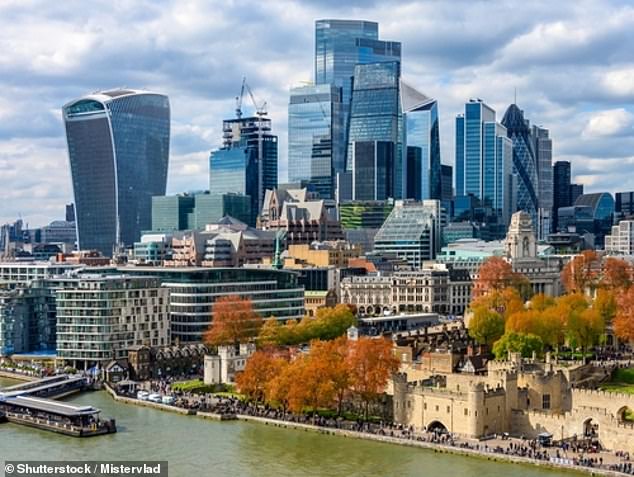
The changes marked another boost to the City after it was spared a banking tax raid in last week’s Budget
The Bank said that after the reduction ‘banks should have greater certainty and confidence in using their capital resources to lend to UK households and businesses’.
The new rules were published as the Bank published its latest Financial Stability Report as well as a stress test for lenders.
It found risks to financial stability were rising, citing geopolitical tensions, trade wars and pressure on government lending markets as well as cyber attacks.
The Bank also reiterated warnings over a potential artificial intelligence (AI) bubble, pointing to the huge valuations of tech stocks focused on the technology.
It said US stock valuations were ‘close to the most stretched they have been’ since the so-called ‘dotcom bubble’ 25 years ago and in the UK since the global financial crisis of 2008.
‘This heightens the risk of a sharp correction.’
However, the Bank judged that the UK financial system was ‘able to continue to support the economy even if economic and financial conditions turn out to be materially worse than expected’.
Its stress test showed Britain’s seven biggest lenders – Barclays, HSBC, Lloyds, NatWest, Santander, Standard Chartered and Nationwide, have enough capital to withstand a deep global recession, large falls in financial markets and a jump in interest rates.
Matt Britzman, senior equity analyst at Hargreaves Lansdown, said: ‘The UK’s seven biggest banks sailed through the latest stress test, reaffirming their resilience and earning a regulatory nod to ease capital buffers.
‘Most banks already hold capital well above the minimum by choice, so any shift in strategy may take time – but in theory, it
‘However they use the new freedom, this is another clear signal that the UK banking sector is in robust health.
‘This was largely expected, but the confirmation should still be taken well, especially after dodging tax hikes in last week’s Budget.
‘UK banks have been on a tear over the past two years from deeply depressed levels – valuations aren’t as cheap anymore, but there are still some solid catalysts in play and the potential for strong shareholder returns ahead.’
DIY INVESTING PLATFORMS

AJ Bell
AJ Bell
Easy investing and ready-made portfolios

Hargreaves Lansdown
Hargreaves Lansdown
Free fund dealing and investment ideas

interactive investor
interactive investor
Flat-fee investing from £4.99 per month

Freetrade
Freetrade
Investing Isa now free on basic plan

Trading 212
Trading 212
Free share dealing and no account fee
Affiliate links: If you take out a product This is Money may earn a commission. These deals are chosen by our editorial team, as we think they are worth highlighting. This does not affect our editorial independence.

