

Hundreds of thousands of graduates are now claiming benefits, with new figures showing a sharp post‑pandemic rise in the number of people who say they are too sick to work.
Analysis by the Centre for Social Justice found 707,000 people with a university degree were out of work and claiming one or more benefits at the end of last year — a 46 per cent increase compared with pre‑lockdown levels in 2019.
The rise has been driven largely by a doubling in the number of graduates who say they cannot work because of a health condition.
The number of degree‑holders out of work for health reasons climbed from 117,000 in 2019 to 240,000 in 2025, an increase of more than 100 per cent.
The figures mean one in three graduates who are not working now cite a health reason for being out of employment.
The think tank said growing numbers of students were completing degrees that do not align with the skills employers need, leaving many reliant on benefits after finishing university.
It questioned the value of so‑called “Mickey Mouse degrees”, warning they saddle students with debt while failing to improve their earnings prospects.
Its analysis also highlighted a trend of graduates moving directly from university onto sickness benefits following the pandemic, with more than eight in ten under‑30s on Universal Credit saying they were claiming for health reasons.
The findings have drawn cross‑party attention, including support from former education secretary and Conservative peer Michael Gove and from Reform UK.

Graduates continue to struggle after leaving University amid a weak job market
|
GETTY
Richard Tice, Reform’s deputy leader, said: “Too many people are doing poor quality degrees, racking up debt, then thinking they can make a lifestyle choice not to work.”
Shadow business secretary Andrew Griffith said many graduates “would want to work” but were struggling in a difficult job market.
He added stories of applicants submitting hundreds or even thousands of applications without hearing back “must take a toll on people’s mental health”.
Separate figures show close to a million young people aged 16 to 24 are now neither in work, education nor training, raising concerns about long‑term reliance on benefits among younger workers.
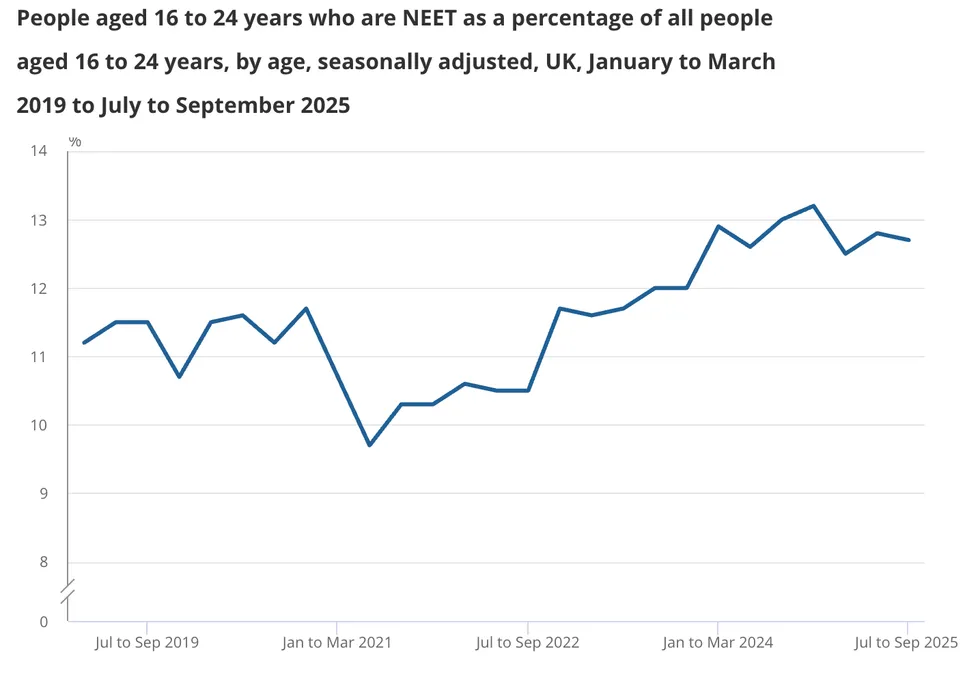
The percentage of young people who are not in education, employment or training (NEET)
|
ONS
At the same time, apprenticeships for school and college leavers have fallen by 40 per cent over the past decade.
The Centre for Social Justice found that higher‑level apprentices now out‑earn the average graduate.
Five years after qualifying, students who completed a level‑four apprenticeship earned almost £12,500 more than graduates from low‑value university courses, and £5,000 more than the average graduate overall.
Even lower‑level apprentices were found to earn as much as, or more than, graduates from lower‑value degrees.
The report also pointed to changes in pay at the lower end of the labour market.
Analysis by the Resolution Foundation showed that 20 years ago the average graduate earned 2.5 times more than a worker on the minimum wage. By 2023, that premium had fallen to 1.6 times.
Daniel Lilley, of the Centre for Social Justice, said policymakers should rethink the assumption that university should be the default route for young people.
He argued that technical education had been treated as a second‑class option for too long, leaving employers struggling to recruit workers with practical and technical skills.
Official statistics show that for every three British young people choosing a university course, just one receives vocational training. In Germany, the split is even, and productivity growth is stronger.

Tesco are among employers helping young people into paid placements
|
GETTY
“If we are serious about repairing broken Britain, we must give young people the opportunity to succeed and fuel key industries with the domestic skills they need to grow,” Mr Lilley said.
A Government spokesman said ministers were “determined to support young people into work and gain the skills they need to succeed”.
He said the Government’s Jobs Guarantee was helping young people into paid placements with employers including E.ON, JD Sports, Tesco and TUI, and highlighted £1.5billion of investment to get hundreds of thousands of young people “earning or learning”, including through expanded apprenticeships and training.
Former health secretary Alan Milburn has been commissioned to lead a review into barriers facing younger people in the labour market.