

Powerful waves have uncovered the remnants of an ancient woodland buried beneath a North Wales beach.
The prehistoric forest emerged along a 40-metre section of Conwy Morfa Beach, next to the local golf course, after recent storms stripped away layers of sand.
Lee Bowman, a resident who regularly walks the shoreline, made the remarkable discovery on Friday.
The exposed site features tree trunks and root systems that have lain hidden beneath the sand for millennia.
Recent turbulent weather created a sand wall approximately 10 metres up the beach, revealing these long-concealed woodland remains to the surface for the first time in living memory.
Mr Bowman described his initial confusion upon encountering the unusual sight during his routine coastal stroll.
“We walk the beach once or twice a week and we’d never noticed them before,” he told North Wales Live.
“This time I saw some flattish timber and at first I thought they were planks from a boat. Then I realised some had root systems.”
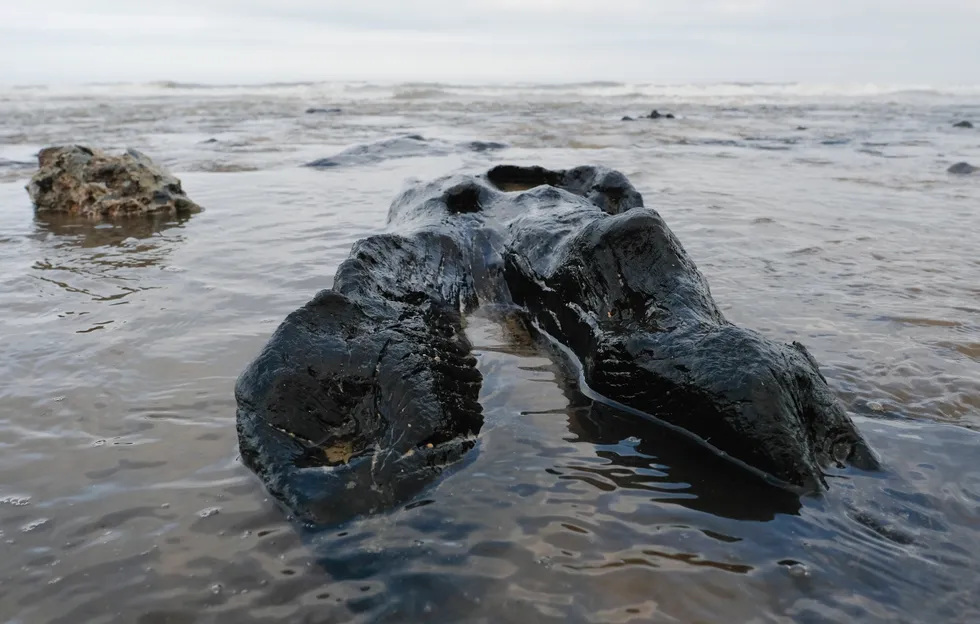
Powerful waves have uncovered the remnants of an ancient woodland buried beneath a North Wales beach (photo from 2018)
|
GETTY
He explained fierce conditions in preceding days had dramatically reshaped the beach’s profile.
“Heavy seas in recent days have scooped out the sand to create a sand wall some 10 metres up the beach, and this is what must have exposed the old trees,” he added.
Wales’s western coastline is well known for such submerged woodlands, which offer tangible connections to ancestral landscapes long since lost to the sea.
Scientific analysis of comparable sites has yielded remarkable findings about their antiquity.
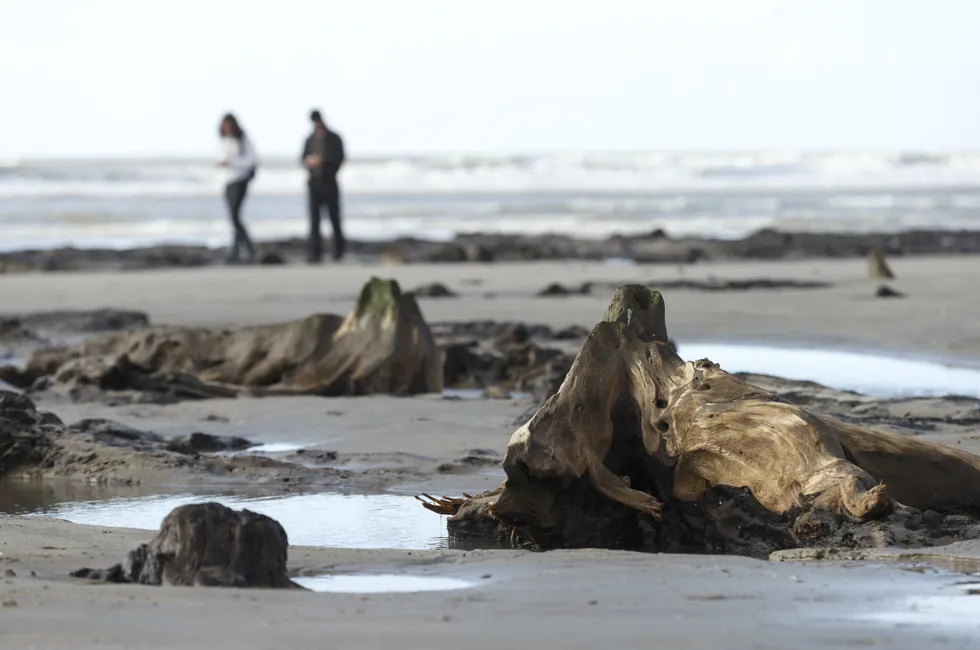
A storm revealed this 5,000 year old tree stumps on the beach in Borth, Wales, in 2014
|
GETTY
At Borth in Ceredigion, where a submerged forest was discovered in similar circumstances in 2014, radiocarbon dating has established that preserved trees date back between 4,500 and 6,000 years, during the Neolithic era.
Oak specimens predominate among these ancient forests, though pine, birch and willow have also survived within coastal peat deposits.
Even older examples exist at Llandudno’s North Shore, where a Bangor University oceanographer dated one stump to 8,000 years old—a period when sea levels sat roughly 10 metres lower than today.
The gradual inundation of these forests as glacial ice melted gave birth to enduring Welsh mythology, including tales of Cantre’r Gwaelod—sometimes called the Welsh Atlantis—a legendary kingdom said to lie beneath Cardigan Bay.
Northern Welsh folklore similarly recounts Tyno Helig, a realm purportedly stretching from Bangor to the Great Orme, whose palace was supposedly swallowed by the sea following a supernatural curse.
These ancient narratives may represent collective memories of genuine coastal transformation as rising waters reshaped Britain’s outline over thousands of years.
Mr Bowman noted that substantial quantities of sand had been displaced, making the ancient trees particularly prominent, though he anticipated they would soon vanish again beneath the shoreline.