
Two Afghan migrants who exploited the dating app Grindr to deceive victims and gain entry to their homes were jailed at Isleworth Crown Court on Monday.
Rahmat Khan Mohammadi, 23, received a five-year sentence while Mohammed Bilal Hotak, 27, was handed three-and-a-half years behind bars.
The pair operated as part of an organised crime network, stealing phones, passports and wallets worth £68,000 during a six-month period ending in March this year.
Their scheme involved pretending to have romantic interest in men they contacted through the LGBT platform, subsequently arranging to visit their targets at home.
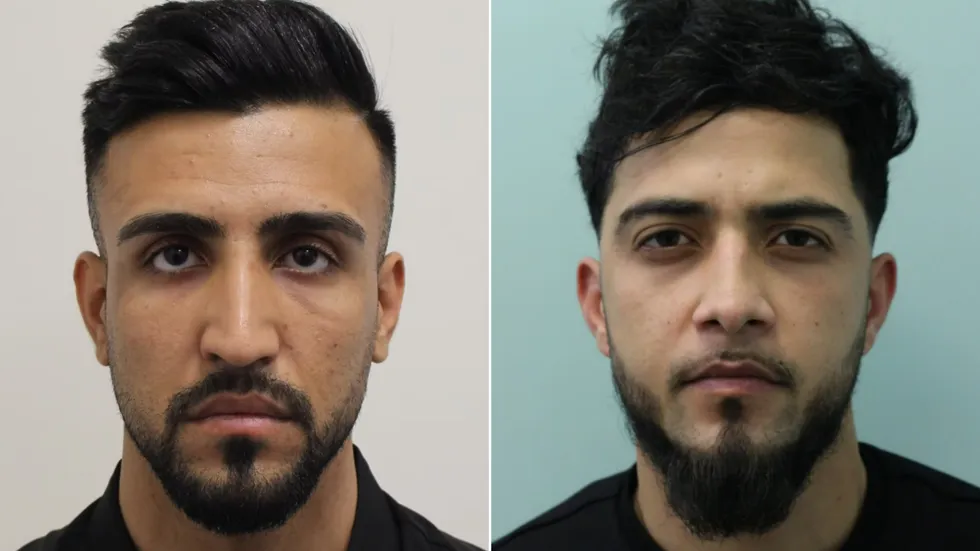
Rahmat Khan Mohammadi (right) and Mohammed Bilal Hotak (left) were jailed at Isleworth Crown Court
|
MET POLICE
The wider criminal operation was responsible for 35 burglaries and 20 connected fraud offences across London during this timeframe.
The criminals typically established Grindr profiles without photographs, sending images of other people when potential victims requested to see them.
Once a meeting was arranged through the app’s messaging function, Mohammadi would sometimes ask to bring along a friend – in reality, his accomplice Hotak.
After entering a victim’s residence, the pair would request that music be played, specifically choosing YouTube because the phone could not be locked whilst a video was running.

The thieving duo received a combined total of eight-and-a-half years behind bars at Isleworth Crown Court
|
PAThey would then obtain the device’s password before creating a distraction to make the victim leave the room – excuses ranged from needing a shower to asking for directions to the toilet.
Upon the victim’s return, the perpetrators and the mobile phone would be gone, with the stolen passwords subsequently used for contactless payments or direct bank transfers.
Judge Adenike Balogun acknowledged the significant harm caused to those targeted, stating: “I have taken note of the psychological trauma as well as the inconvenience caused to the victims, and the distress that all of them have expressed at allowing you into their homes – into their private space – only to be violated.”
Prosecutor David Patience had argued the offences constituted hate crimes because victims were selected based on their sexuality.
MIGRANT CRISIS – READ THE LATEST:
The court heard that the criminals typically established Grindr profiles without photographs
|
PAThe judge carefully considered this argument but concluded the men did not act from hostility towards their victims’ sexual orientation.
Instead, she determined they viewed Grindr as “an opportunity to gain easy access into the homes of the victims” and targeted individuals for their perceived vulnerability.
She added: “I suspect you were – and I put no higher than that – banking on the victims not reporting the crime.”
One victim described losing irreplaceable photographs of deceased relatives stored on his stolen phone, later requiring hospital treatment for severe psychological trauma.
He said: “I strongly perceive this incident as a hate crime – I was targeted specifically on the basis of my sexuality. The suspects used Grindr, a gay dating app, as a hunting ground.”
Another victim, Lester Macabodbod, told the court: “I believe they were looking for gay men because they believed we wouldn’t go to the police.”
Superintendent Owen Renowden, the Met’s hate crime lead, described the offences as “callous, calculated, pre-planned crimes” with devastating consequences.
Detective Inspector Mark Gavin acknowledged that trust in police remains lower among LGBT communities, emphasising that ensuring victims “felt heard, believed and taken seriously” was central to the investigation.


