
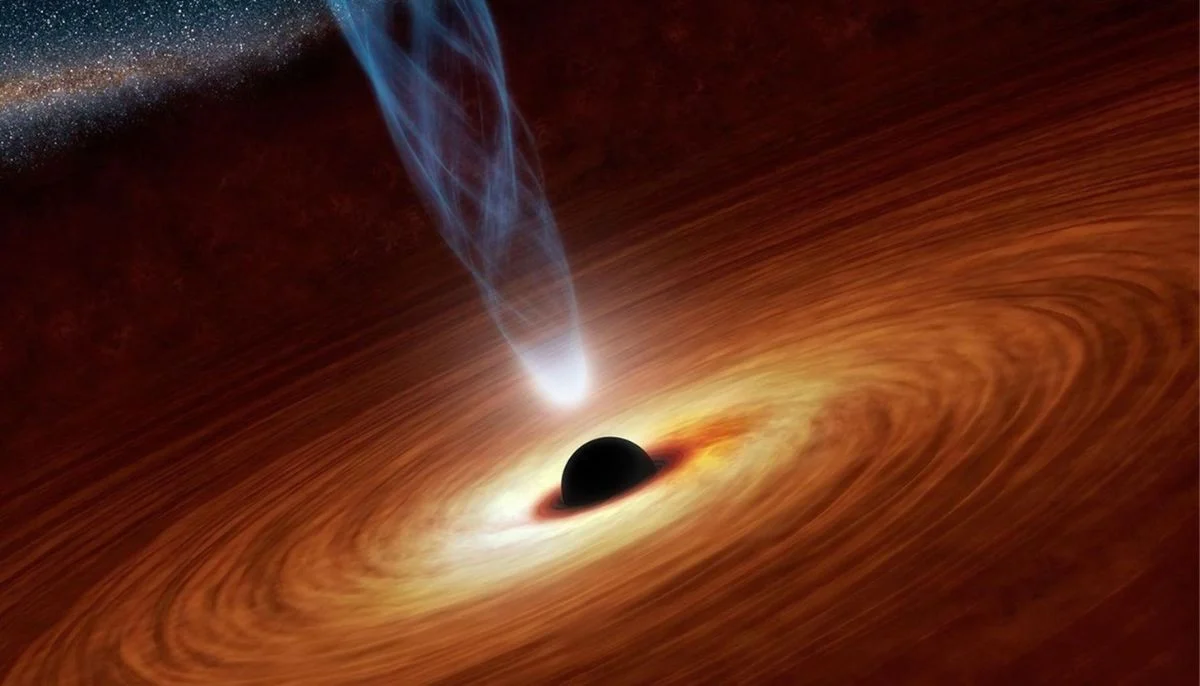
The researchers in a recent breakthrough have successfully modelled luminous black hole accretion, the process of matter falling into a black hole, marking a major “turning point” in black hole research.
The team led by scientists from the Institute for Advanced Study and the Flatiron Institute’s Center for Computational Astrophysics, utilized the most powerful supercomputers to calculate the flow of matter into black holes.
According to findings published in The Astrophysical Journal, the simulation reproduces consistent behaviours seen in real-world telescopes, specifically in ultra luminous X-ray sources and X-ray binaries.
“This is the first time we’ve been able to see what happens when the most important physical processes in black hole accretion are included accurately…What’s most exciting is that our simulations now reproduce remarkably consistent behaviors across black hole systems seen in the sky,” said lead author Lizhong Zhang.
The study also focused on “stellar-mass” black holes, which are roughly 10 times the mass of the sun. Unlike the supermassive black holes which change slowly over time, these stellar mass black holes tend to change over minutes and hours, giving the researchers opportunity to study real-time changes.
The new model also allowed the astronomers to study how matter spirals inward and how they form turbulent and radiation-dominated disks around stellar mass black holes.
Based on the simulations, the team also observed strong winds flowing outward, leading to the formation of powerful jets.
What this study means for future research
The framework is not just limited to studying small black holes. Besides stellar mass black holes, the simulations could be helpful in understanding supermassive black holes and their central role in shaping galaxies.
Future study could also shed light on how radiation interacts with matter across different temperatures and densities.
According to study co-author James Stone, “What makes this project unique is, on the one hand, the time and effort it has taken to develop the applied mathematics and software capable of modeling these complex systems, and, on the other hand, having a very large allocation on the world’s largest supercomputers to perform these calculations.”

