
A shockingly petty sibling squabble broke out amongst five heirs after they were each told they’d inherit a $10 million home as part of their family’s ‘trust reveal’.
The unidentified offspring were exposed in a recent Wall Street Journal article offering a fascinating insight into how and when the offspring of the super-wealthy are told how much their parents plan to give them.
Jen Galvagna, head of trust, estates and tax at the Bank of America, revealed the circumstances around the falling out of the unnamed family.
She told the outlet that the five heirs were to each inherit one of their family’s homes around the world. Three of the properties were worth around $10 million each and were carefully chosen to give the impression of the parents being fair.
Hoping to avoid a sibling squabble, their parents even fixed their trust fund in such a way so that if one received a more expensive home their share of liquid assets fell.
But Galvagna said insults and accusations were soon flying.
‘People were questioning why they got this house, and not the other house’, she told the outlet.
The ungrateful siblings nitpicked over the location of their respective mansions – with one on water the most sought after – as well as how well they’d been renovated.
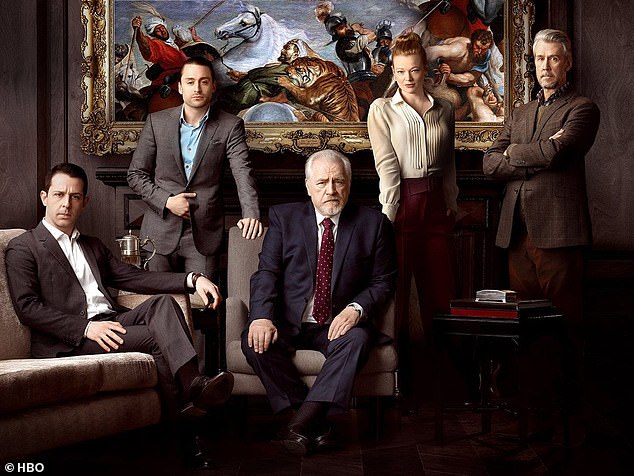
HBO’s hit drama Succession saw the offspring of media magnate Logan Roy (played by Brian Cox, center) locked in a series of petty and personal squabbles over their inheritance. And the super-rich behave just the same way in real life, experts say
The enviable drama calls to mind HBO’s hit series Succession, in which the cosseted and lazy children of media magnate Logan Roy (Brian Cox) fought over what they perceived to be their dues.
According to those who spoke with the Journal, the most popular structure for the uber rich involves a dynasty trust.
Those trusts enable their holders to move wealth down through a potentially infinite number of generations in a way that can legally avoid estate and inheritance taxes.
Galvagna told the outlet that she worked with a trust that was set up specifically to help fund a child’s equestrian hobby.
The fund was filled with $75 million and allowed the client’s daughter to buy and stable horses, cover medical bills, hire instructors and insure the animals.
Galvagna said the trust allowed for further distributions tied to the girl’s education, health and other expenses.
Another family put an emphasis on money being paid out of their fund specifically for travel, in the hopes that their children would see the world.
Galvagna said that the fund allowed for a $300,000 annual disbursement just for vacations.

Jen Galvagna, head of trust, estates and tax at the Bank of America, seen here, revealed the circumstances around the falling out of the unnamed family

According to those who spoke with the Wall Street Journal, the most popular structure for the uber rich involves a dynasty trust
Other experts say ultra-rich parents are keen to provide for their children while emphasizing the need for them to work hard and contribute to society.
Some trusts will match an heir’s existing income to motivate them to progress through their career and climb the ladder.
Others pay out bonuses if a heir graduated with a certain grade average, or if they earned a four-year degree.
They are typically stuffed with stocks, bonds, cash, properties and family heirlooms but some occasionally contain businesses or other assets.
Sunil Tolani, a hotel entrepreneur, told the outlet that a Holiday Inn Express he owns and other hotels are all in a trust fund for his sons.
As well as the properties, his personal homes, gold jewelry, watches and his wife’s Hermes handbags are all included.
Tolani said: ‘The biggest gift you can give to the people you love is to create an estate plan.’
Luke Jernagan works with families in breaking the news of the value of their trust funds to their children.
He told the outlet that he helps write scripts for them and his firm will actually host the meeting, saying: ‘I’ve never been to one of those where people weren’t teary.’
According to the outlet, one of the reasons families start to disclose the true values of the funds is if they suspect one of their children is on the verge of marrying.
Failing to have that talk can prove difficult, a Fidelity survey found this year that 68 percent of parents hadn’t told their children what they would inherit.
Over half hadn’t discussed their net worth with their kids, fearing that their may blow the money.
According to Cerulli Associates, over $100 trillion will be passed down to younger generations and to charities until 2048. Around $62 trillion will come from high-net-worth individuals.
Trusts and estates have already generated $290 billion in income for beneficiaries this year alone. If that figure keeps on track, it will blow a record that dates back to 2003, according to tracker IBISWorld.