

Across Britain, 152 additional local authorities could fall within the inheritance tax net once pension savings are included in estate calculations from April 2027.
Research conducted by The Private Office examined average property values across 372 local authorities alongside estimated pension wealth based on median earnings.
The findings indicate that the total number of areas potentially exposed to inheritance tax could rise to 288 once the planned pension reforms come into effect.
Until now, unused pension funds and certain death benefits have remained outside inheritance tax calculations.
The proposed changes would significantly expand the scope of the levy by allowing pension savings to be counted as part of an individual’s estate.
Figures from HM Treasury show the Government collected £8.25billion in inheritance tax during the 2024/25 tax year.
Treasury projections suggest annual revenues from inheritance tax could exceed £9billion by the 2026/27 tax year.
The largest changes are expected in mid-priced areas across the Midlands, South West and East of England, where property values currently sit close to the tax threshold.
Local authorities such as Stevenage, Tewkesbury and Mid Suffolk currently fall just below the inheritance tax threshold when property values alone are considered.

Changes to add 288 authorities into inheritance tax
|
GETTY
When estimated pension wealth is included, average estates in these areas could face inheritance tax bills ranging between £10,000 and £60,000.
In Stevenage, for example, an average property valued at around £315,429 combined with an estimated pension pot of £154,580 would produce a total estate of approximately £470,009.
That would generate a potential inheritance tax liability of roughly £58,003.
Similar patterns were identified in Thurrock, Braintree, Rutland, Ribble Valley, Warwickshire, the City of Edinburgh and Gloucestershire, where pension savings push average estates above the tax threshold.
The largest inheritance tax liabilities remain concentrated in affluent areas of London and the South East.

The squeeze on household finances continues to tighten
|
GETTY
In Kensington and Chelsea, property values alone would generate an estimated inheritance tax bill of about £343,924.
When pension wealth is included, that figure could rise to approximately £405,211, with total estate values exceeding £1.3million.
Other London boroughs including Camden, Richmond upon Thames, Hammersmith and Fulham and the Surrey district of Elmbridge are also projected to see average inheritance tax liabilities exceed £200,000 once pensions are included.
Commuter belt areas such as Guildford, St Albans, Windsor and Maidenhead and Wokingham are also expected to remain well within inheritance tax territory.
Lower value areas in northern England and coastal regions are less likely to face significant inheritance tax exposure even after pension wealth is added to estates.
Locations including Burnley, Hartlepool and Blackpool are expected to remain largely below the threshold.
Pippa Vick, a financial adviser at The Private Office, said the changes could widen the number of households affected by inheritance tax.
Ms Vick said: “Inheritance tax is increasingly becoming a property tax by default.”
She added: “Many families don’t consider themselves wealthy yet long term house price growth particularly in London and the South East means their estates can face substantial tax bills.”
Ms Vick said early planning could help reduce the potential tax burden for families.
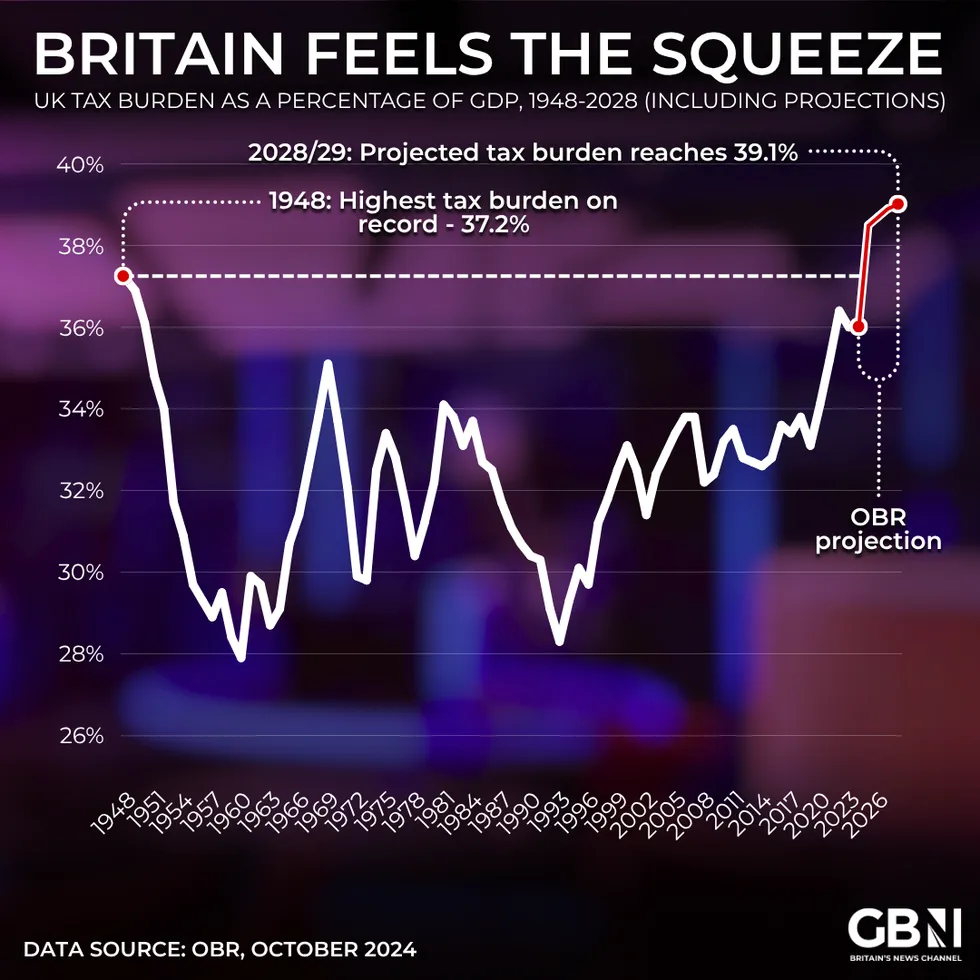 Tax Burden as a percentage of GDP | GETTY
She said: “Without proper planning beneficiaries may be forced to sell assets simply to settle the liability.”
Ms Vick said seeking financial advice and using structured estate planning strategies could help reduce inheritance tax exposure.
The inheritance tax nil rate band has remained frozen at £325,000 since 2009 and is scheduled to stay at that level until the 2030/31 tax year.
Married couples and civil partners are able to combine their allowances, potentially allowing them to pass on up to £1 million tax-free when the residence nil rate band is included.
This higher allowance applies provided the total value of the estate remains below £2million.