

The economic impacts of the Iran war are already being felt in global markets, and could raise energy prices and wider consumer bills in the UK before long.
The immediate impact of American and Israeli attacks on Iran, and Tehran’s retaliatory strikes on numerous neighbours in the Middle East, has been to push up oil and gas prices.
The Persian Gulf that separates Iran in the north from Saudi Arabia, Qatar and the UAE in the south, is the most important fossil fuel artery in the world, and for now it is effectively closed.
Iranian military threats against ships transiting the Strait of Hormuz have rendered vessels uninsurable, and on either side of the narrow passage north of Ras-al-Khaimah, scores of vessels are at anchor awaiting instruction.
Markets latest: Natural gas costs up 93% since Iran war began
Direct Iranian attacks on major oil and gas terminals in Saudi Arabia and Qatar, a crucial producer of liquid natural gas (LNG), make it clear that Iran considers energy infrastructure a legitimate target as it tries to make the conflict as painful as possible for Washington’s allies.
Oil prices have risen around 18% since the conflict began, pushing Brent crude close to $83 a barrel, and bringing an abrupt end to a period of relative price stability brought about by relative oversupply.
The increase will inevitably be felt at petrol pumps in due course, with wholesale petrol prices already up 2.3% and diesel prices 7%.
The more dramatic impact could be on energy prices, courtesy of the UK’s exposure to wholesale gas prices.
Gas is central to the UK economy because of its central role in the electricity system. It’s not just a source of heat and power, providing crucial flexible capacity, but it also sets the price for all sources of electricity in the market.
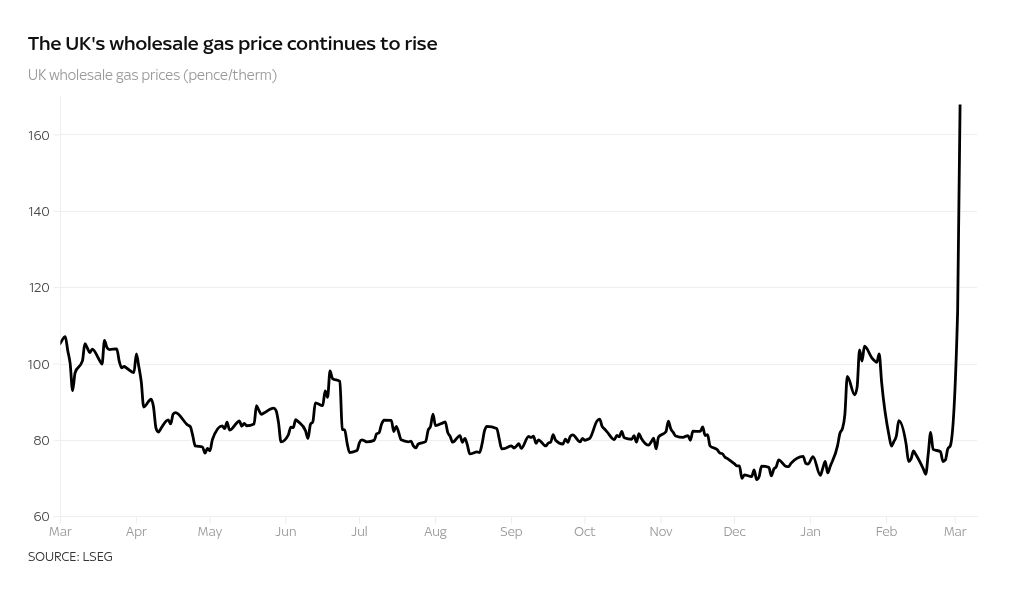
So when gas prices increase, as they have done in the last four days, we feel it acutely. UK wholesale gas prices have more than doubled since the weekend, pushing the price above 150p a therm.
That increase is dramatic and has prompted the highest-ever spike in the electricity wholesale market, but is not yet comparable with the ruinous rises that followed the Russian invasion of Ukraine.
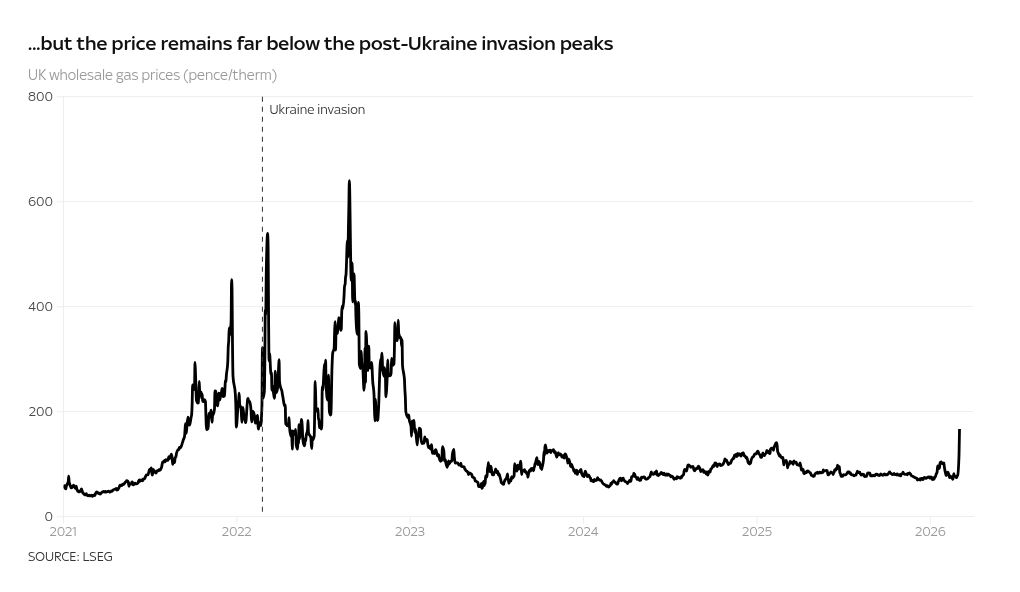
Then UK gas prices were above 600p a therm, pushing average energy bills above £4,000 a year and triggering an £80bn state bailout of domestic energy bills.
If sustained, volatile gas prices will be felt by households, and British business and industrial users already facing the highest energy prices in the developed world.
There will be no immediate impact on domestic bill payers because the most recent price cap, set by Ofgem last week and applicable from April to June, has capped the maximum price seven% lower than today.
The outlook beyond June is deeply uncertain however. Ofgem bases its price cap on data gathered in the preceding three months, a window that has just opened and will include the price shocks caused by war in the Middle East.
It is never a bad idea to review your energy tariff but now may be an opportune moment to consider whether fixed rates offered today are likely to be available come the summer.
Industry does not have the luxury of a price cap and, depending on their contracts, business users may have no cushion against bill increases. If this conflict lasts, expect pressure on the government to reduce energy costs to increase.
The conflict has already reopened debate in the UK about government energy policy that is focused on expanding renewable capacity to cut emissions and, in the phrase favoured by Energy Secretary Ed Miliband, “end the fossil-fuel rollercoaster”.
Net Zero is now a dividing line in British politics, with Labour committed to going further and faster, while the Conservatives have disavowed a policy they introduced, and Reform UK have sought to weaponise it.
The attack on Iran provides ammunition for both sides. For advocates of Net Zero, rising oil and gas prices underline the need to develop long-term alternatives, despite the rising transitional costs.
For opponents and many politically agnostic observers interested in sustainably lower prices, they demonstrate the need to maximise domestic fossil fuel reserves in the North Sea.
Read more:
Iran’s people left without a voice as communications cut off
This war has massive implications for the world economy
Labour has banned new drilling licences and extended a windfall tax on oil and gas producers, pointing to evidence of a shrinking basin in which reserves are in long-term decline.
Oil and gas extracted from the North Sea is sold on international markets and so cannot provide a discount, but the Conservatives are not alone in pointing out that, at the very least, domestic production comes with lower emissions than imports.
Expect these arguments to intensify politically, economically, and in a culture war intensified by real war, and the undeniable industrial impact of high energy prices.
No one can say with certainty whether this conflict is a spasm or the precursor to a prolonged campaign but, either way, consumers will feel it.