

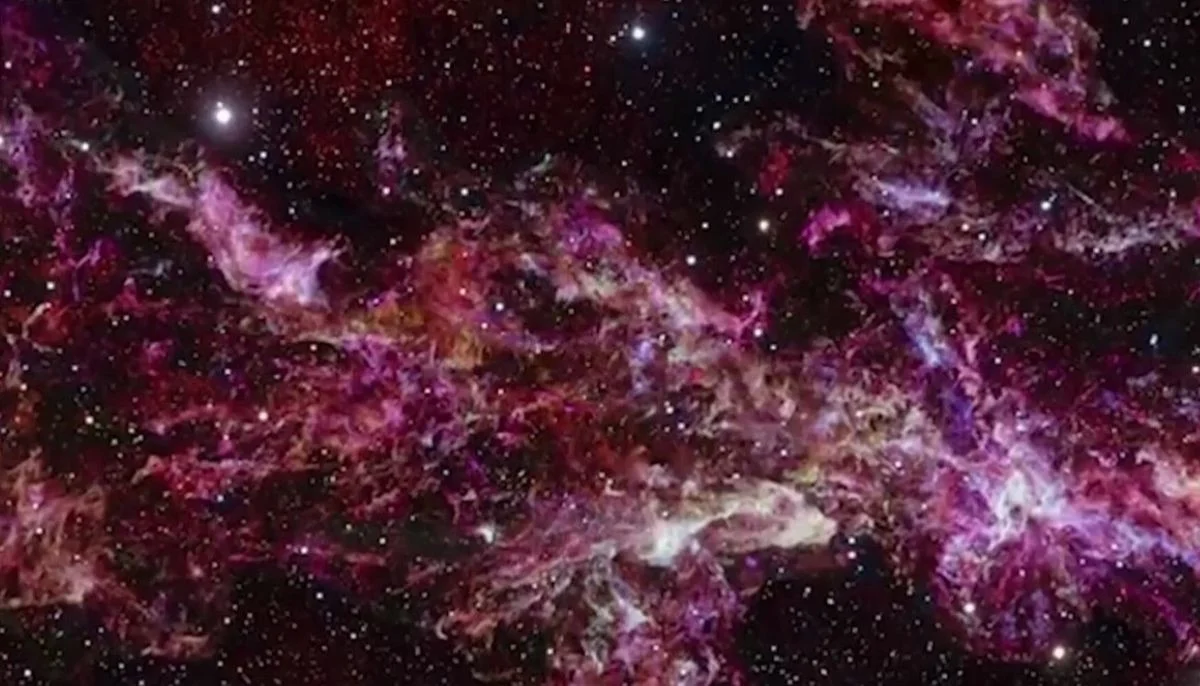
Astronomers have unveiled an intriguing discovery: the largest image ever produced by the ALMA telescope, providing a groundbreaking look at the Central Molecular Zone referred to as the heart of our Milky Way. Appearing as purple and pink clouds caught in a current, this photo actually demonstrates the gas responsible for star formation at the heart of our galaxy.
In this connection, Steve Longmore, Professor of Astrophysics at Liverpool John Moores said: “This image gives us a window into how stars and planets form when they’re close and packed together, which we think is how most stars in the universe formed.”
This photo gives us a glimpse of a region spanning more than 650 light-years, made up of cold cosmic gas under extreme conditions invisible to our eyes. It is the largest image ever taken by the 66-antenna ALMA network in the Atacama Desert in Chile.
The heart of the Milky Way is typically hidden by thick cosmic dust, but recently released photos reveal a complex web of gas filaments. These structures channel material into dense clumps where new stars are born. These recent discoveries offer enchanting views reminiscent of early galaxies; by studying one can better understand how the first stars in the universe were created.