

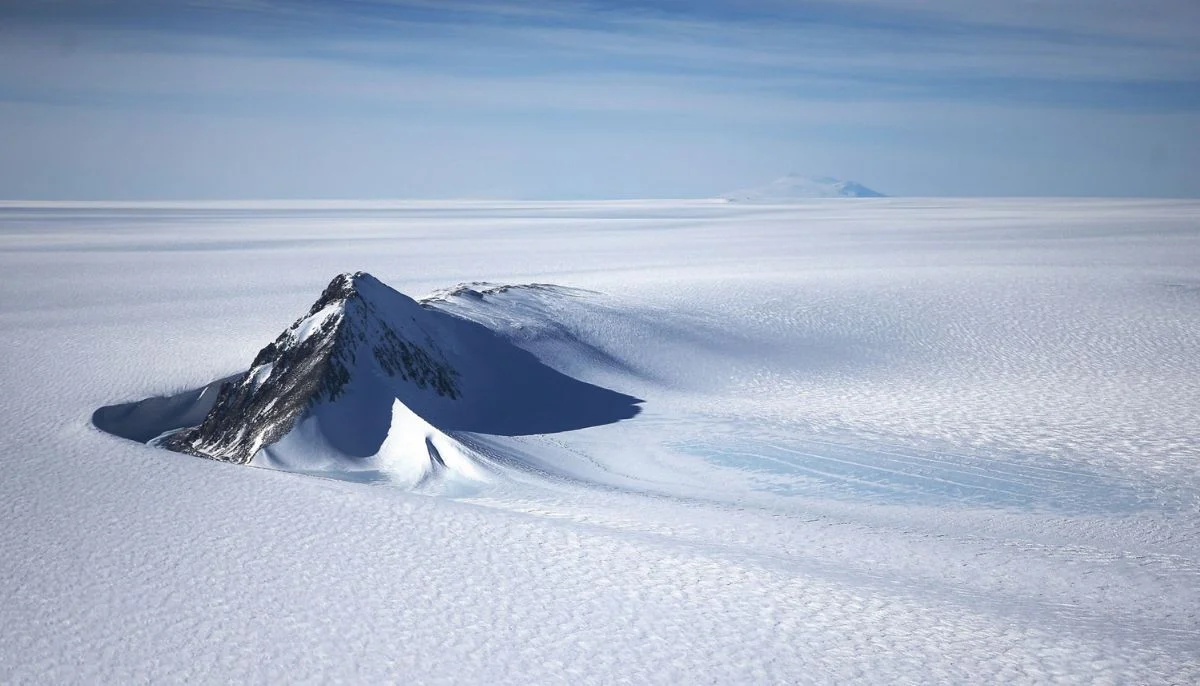
According to a new study, researchers have identified a massive gravity hole-technically known as a Geoid Low-beneath the Antarctic ice surrounding the Southern Ocean. This discovery is providing a window into Earth’s deep interior, serving as a dynamic record of slow-moving processes that have been reshaping our planet for tens of millions of years.
The term gravity hole sounds alarming but it suggests a local hazard; however it poses no physical threats to people. Instead, this profound anomaly reveals how material is arranged within Earth and how that distribution has evolved over geological time.
The phenomenon occurs because when Earth’s gravitational pull is slightly weaker, as it is in Antarctica, the ocean’s gravity-defined surface called the geoid-sits closer to the planet’s center. The Antarctic Geoid Low is one of those valleys, and in geodynamic models, it is the deepest long-wavelength valley on the planet.
Study co-author Alessandro Forte said: “What surprised me most is how coherent the long-term story appears to be. The gravity low is not a random, but a short-lived feature. In our reconstructions, it persists through much of the last 70 million years, but its strengths and geometry evolve in many ways..”
Unlocking the secrets of Earth’s deep interior
Earth has other large gravity anomalies but Antarctica’s gravity hole stands out due to its exceptional size, long-wavelength and persistence over tens of millions of years.
Beyond Earth, the study carries implications for planetary science. Long-wavelength gravity anomalies are fingerprints of interior dynamics-clues to how heat escapes a planet and how dense material sinks. On worlds such as Mars and Venus, orbital data reveals gravity variations that hint at ancient, large-scale geological activities.
The findings of the study represent a decade of work built on long-standing collaborations with UT Austin seismologists, who helped to develop crucial imaging of Earth’s interior.