
David Bowie‘s daughter has revealed the harrowing details of being forcibly removed from her family home and sent to multiple treatment centres, forcing her to be away from her father as he lost his battle with cancer.
Alexandria ‘Lexi’ Jones, 25, shared the heartbreaking account in a video posted on Instagram on Thursday, explaining how she had struggled with the pressures of growing up in the spotlight and battled depression and an eating disorder.
Then when her father was diagnosed with liver cancer in 2014, Lexi said she hit ‘breaking point’ and turned to drink and drugs to cope. The music legend died January 2016 aged 69, just two days after he released his final album Blackstar.
Lexi, whose mother is supermodel Iman, 70, described how she was just 14 when two men ‘well over six feet tall’ came to take her to a treatment facility.
She also recalled her father writing her a heartfelt letter when revealing the decision to send her to the facility, which read: ‘I’m sorry we have to do this’.
Looking back on her childhood she said: ‘Adults would talk to me differently than they would talk to other kids. Some were not interested in me as a person at all, and only as a proximity to something else.’

David Bowie’s daughter Alexandria ‘Lexi’ Jones has revealed the harrowing details of being forcibly removed from her family home and sent to multiple treatment centres

As a result she was away from her father as he lost his battle with cancer (Lexi as a child pictured with David)

Lexi explaining how she had struggled with the pressures of growing up in the spotlight and battled depression and an eating disorder before falling into drugs (pictured with mother Iman)
She added that she felt like she ‘existed as an idea’ rather than a real person, with constant projections and expectations from others.
She continued: ‘Something hit me pretty young before I was around ten. I started seeing a therapist because my teachers noticed something was off, and so did my parents. That was around the time I had my first anxiety attack.
‘I started to feel depressed. I was failing school. I had learning disabilities, that made everything feel harder, and I hated the way I looked. I developed bulimia when I was 12. I started self-harming when I was eleven.
‘I felt stupid, incompetent, unworthy, useless, unloveable, and having successful parents only made it worse. It felt like I would never live up to them. I couldn’t understand how I came from people that were thriving in every single direction while I was failing at everything.’
Following her father’s diagnosis and turning to drink and drugs to cope, she said: ‘Everyone around me was experimenting. But for me, it wasn’t about fun. I wasn’t experimenting, I was escaping,
‘When the party ended for everybody else, I kept going, and I drank and got high alone. I became someone who lashed out. I was cruel to people who didn’t treat me the way I wanted to be treated. I was begging to be respected by becoming something people feared, or at least noticed.’
Eventually, she said, an intervention occured that was both unexpected and deeply traumatising.
She said: ‘My dad read a letter he had written. I don’t really remember what it said, but I do remember the last line and it said, “I’m sorry we have to do this.”

She explained how she had struggled with the pressures of growing up in the spotlight and battled depression and an eating disorder

She also recalled her father writing her a heartfelt letter when revealing the decision to send her to the facility, which read: ‘I’m sorry we have to do this’
‘Then two men came through the door, and they were both well over six feet tall. They told me I could do this the easy way or the hard way. I chose the hard way. I resisted. I screamed. I held onto the table leg.
‘They grabbed me, they put their hands on me, they pulled me away from everything I knew and I was screaming bloody murder. I was screaming for someone to help me, but no one did…
‘I felt stripped of any right to stay in my own life. They got me back into a black SUV and shoved me inside. By the time the door shut, my parents were already gone. I was alone. I was in a car with two strange men that wouldn’t tell me where we were going and I just sat there completely horrified and silent.’
Lexi said she spent 91 days at a ‘wilderness therapy’ programme living outdoors in winter conditions with no privacy, showering once a week, and being forced to count out loud every time she used a makeshift bathroom so staff could monitor her.
Wilderness therapy, also known as outdoor behavioural healthcare, is a highly controversial style of mental health treatment developed in the US for adolescents and young adults.
It combines intensive outdoor activities with counselling to purportedly address behavioural, emotional, and substance abuse issues.
Paris Hilton, 45, has become a prominent campaigner against such facilities after alleging she was abused as a teenager at Provo Canyon School in Utah in the 1990s. She testified before Congress in 2021 and successfully lobbied for the Stop Institutional Child Abuse Act, which passed in December 2024.
Lexi said of her arrival at the centre: ‘They strip-searched me, they made sure I wasn’t hiding anything in or on my body. They did kindly hold a sheet up in front of me while I was undressing so I wouldn’t be exposed all the way.

Lexi said she spent 91 days at a ‘wilderness therapy’ programme living outdoors in winter conditions with no privacy, showering once a week

Paris Hilton, 45, has become a prominent campaigner against such facilities after alleging she was abused as a teenager at Provo Canyon School in Utah in the 1990s.

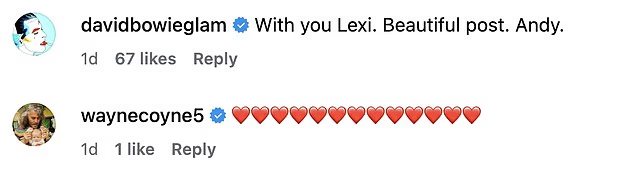
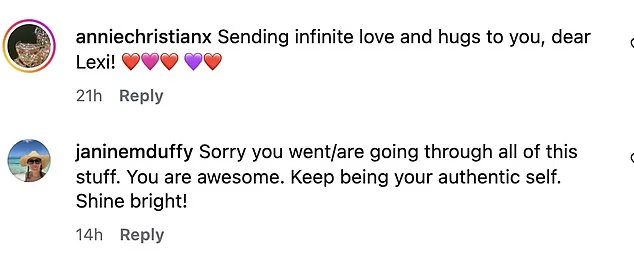
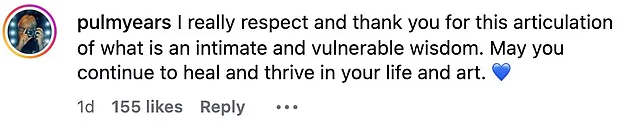

Fans and famous friends including Cara Delevingne were quick to show their support in the comments
‘And they handed me clothes, which was a blue fleece, crew neck, snow pants, a kind of greenish jacket and hiking boots, and a giant a** backpack that was bigger than me at the time. I had never heard of anything like this before. I didn’t know wilderness therapy existed. I was a city girl.’
She added of their way of living: ‘We dug holes in the ground to be used as bathrooms far away from the site. And every time we used the bathroom, you had to count out loud so that staff would keep track of us.
‘We made fires by stripping birch bark and striking flint and steel. We cooked our meals over those fires and learned how to tie knots to set up tarps and we would sleep under those tarps on a yoga mat and a sleeping bag.’
When new arrivals reached the programme, she said they were ‘not allowed to talk to anybody in the group’, adding: ‘You’re considered a potential safety risk until they can evaluate your behaviour and decide if you’re fit to be incorporated in the group.’
After three months in wilderness therapy, Lexi was sent directly to a residential treatment centre in Utah for 13 months. ‘I was strip-searched again,’ she said. ‘I had to be watched while I slept. I had to count every time I used the bathroom.’
It was there that she learned her father had died: ‘I had the luxury of speaking to him two days before, on his birthday,’
‘I told him I loved him, and he said it back, and we both knew. Then I saw the post, the one that said something like, David Bowie passed away, surrounded by his whole family.
‘It made me physically ill because, yeah, the whole family was there. Except for me.’
She continued: ‘I’ve accepted it. I’ve tried not to internalise it or feel guilty but sometimes I still have those moments where I wish things were to be different.
‘Processing his death became a whole new layer of the programme. They created a special phase for me called The Grief and Loss Phase. They structured my grief. They categorised it and assigned milestones and expectations.
‘At the time, I thought that was normal. I had never lost anyone that close to me and I didn’t know how to grieve. And that was my only frame of reference.’
After finally returning home from Utah shortly before turning 16, Lexi said she ‘slipped back into old patterns’ and was eventually sent away to another programme.
‘This repetitive cycle of being sent away made everything start to blend together,’ she explained. ‘The ache of being away from my life, my people, myself, made me feel like a problem that was being passed off.’
Lexi acknowledged that her experiences have shaped who she is today, making her ’emotionally intelligent, introspective, not afraid to reflect on some of the harder things’.
She added: ‘I was forced to look inward before I even had a chance to look outward. I had to understand emotions before I understood algebra. I had to become fluent in the language of healing before I even knew who I was.’
But she also described lasting effects: ‘I still flinch sometimes when things feel too controlled and I still get the urge to scan the room for rules I haven’t been told yet.’
Lexi released her debut album Xandri in April 2025. The 12-track record was created independently with Lexi writing, producing, and performing all the songs herself.
David and Iman married in 1992 and remained together until his death in 2016. Lexi has a half-brother, film director Duncan Jones, 54, from Bowie’s first marriage to Angie Bowie.
Lexi said she was sharing her story ‘to make this real so that it’s not just a memory I carry in private’. She added: ‘The point is to talk about what no one talks about: the parts of yourself you lose in the process of being fixed. The point is that this happened to me and to a lot of other kids that deserve better.
‘I go back and forth with myself about it all the time, and I feel guilty for thinking badly of it. I try to justify it because I wasn’t physically abused, at least not after the whole escorting situation.
‘I know how lucky I am because that’s not the case for a lot of kids. But still, the mental and emotional manipulation I experienced is something I will not forget. And I won’t pretend it didn’t happen because that is abuse too.’
Fans and famous friends were quick to send their support with Cara Delevingne a string of love heart emojis.
Meanwhile other followers wrote: ‘I really respect and thank you for this articulation of what is an intimate and vulnerable wisdom. May you continue to heal and thrive in your life and art’: ‘Sending infinite love and hugs to you, dear Lexi!’: ‘orry you went/are going through all of this stuff. You are awesome. Keep being your authentic self. Shine bright!’.
If you have been affected by this article call CALM on 0800 58 58 58