

Britain could deploy solar farms in orbit as part of efforts to meet its net zero commitments, according to a government study released yesterday by the Department for Energy Security and Net Zero.
The report outlines what may be the most ambitious proposal yet in Ed Miliband’s drive to decarbonise the country’s energy supply by 2050.
“Space-based solar power could provide Great Britain with constant, predictable, zero-carbon power at the GW scale that displaces both intermittent renewables and fossil fuel generation,” the report stated.
The study was originally commissioned in 2021 by then-Conservative business secretary Kwasi Kwarteng, who tasked the Frazer-Nash consultancy with examining the concept.
The technology would involve satellites fitted with lightweight solar panels harvesting energy while in orbit around Earth.
“A space-based power system involves one or multiple satellites equipped with lightweight solar panels capturing the sun’s energy in space,” the report explained.
Once collected, this energy would be transformed into microwave radiation and transmitted down to receiving stations on the ground.
“The satellite generates electricity, converts it into microwave radiation and beams it to a ground-based rectifying antenna (rectenna). The rectenna converts the microwave energy into electricity,” the study detailed.
 Energy Secretary Ed Miliband has revealed plans to allow homeowners to install wind turbines in their gardens without planning permission | GETTY
Solar panels would be assembled on the satellites before launch.
While initial expenses would be substantial, the report suggests costs could drop significantly as the technology matures, reaching between £87 and £129 per megawatt hour by 2040.
These figures compare favourably with new nuclear power, which is projected to cost around £150 per MWh.
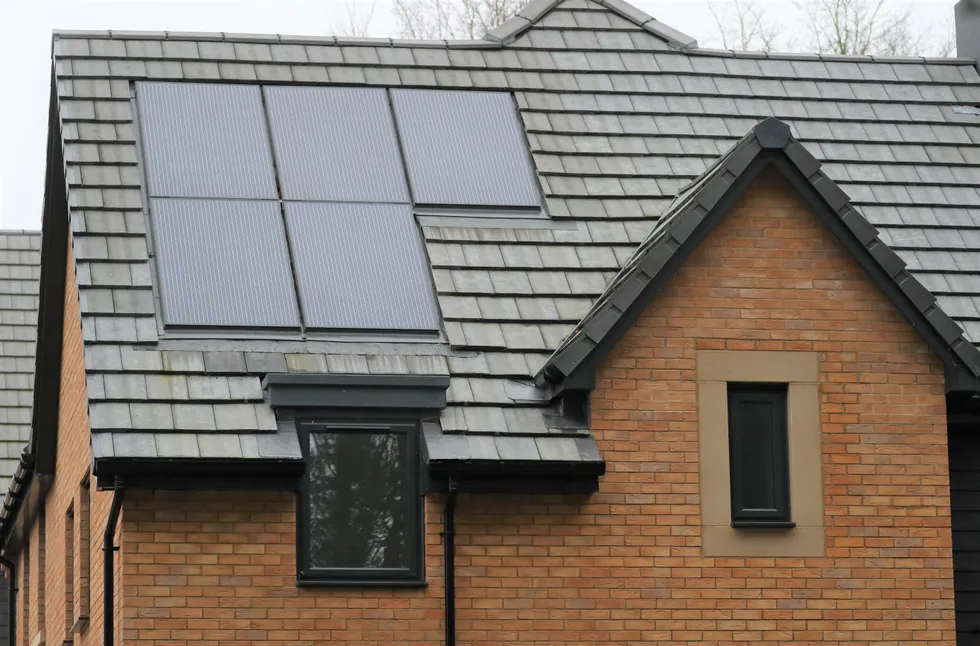 Downing Street said the panels should be installed on as many new properties as possible | PA
Recent offshore wind agreements have seen fixed turbine operators offered approximately £90 per MWh, while floating wind installations command roughly £216 per MWh.
The competitive pricing could mean space-based power stations become eligible for contracts for difference, the same subsidy mechanism currently supporting renewable energy projects like wind farms, guaranteeing operators a minimum price for their electricity output.
The report cautioned that government support would be essential during the early development phase, recommending investment in a smaller-scale system that could later be expanded once investor confidence had grown.
 Ed Miliband has been criticised for hiking people’s energy bills | GETTY
“Without prior de-risking, the scale of the upfront investment required for the first large-scale system may deter investors, making it more difficult to unlock the full benefits of space-based power,” the study warned.
Britain is not alone in pursuing this technology. The European Space Agency is progressing through its Solaris research programme, with a demonstration satellite being planned, while China aims to have a gigawatt-scale orbital power station operational by 2050.
UK start-up Space Solar has been collaborating with the UK Space Agency on self-assembling orbital power stations.