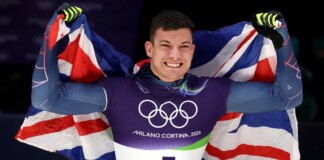

Ukrainian skeleton athlete Vladyslav Heraskevych has been denied his appeal at the Court of Arbitration for Sport on Friday, ending his hopes of competing at the Milan Cortina Winter Olympics after he refused to remove a helmet featuring images of more than 20 Ukrainian coaches and athletes killed during Russia’s invasion.
The 26-year-old was barred from competition by the International Olympic Committee before Thursday’s opening heat of the men’s skeleton event.
Despite the ruling going against him, Heraskevych expressed no remorse for his stance.
“From Day 1, I told you that I think I’m right,” he said, wrapped in a Ukrainian flag. “I don’t have any regrets.”
 Vladyslav Heraskevych has levelled accusations of ‘betrayal’ against the International Olympic Committee | GETTY
The Ukrainian slider was defiant in his assessment of the governing body’s position.
“I think it’s the wrong side of history for the IOC,” Heraskevych said.
The confrontation between Heraskevych and Olympic authorities reached its climax when IOC president Kirsty Coventry travelled to Cortina’s sliding track in a final bid to persuade him to abandon the memorial helmet for competition.
The meeting proved unsuccessful, with the athlete and his father emerging from discussions with Coventry having refused to change course.
Heraskevych had worn the helmet during training sessions throughout the week, believing it complied with Olympic regulations.

IOC president Kirsty Coventry had pleaded with Vladyslav Heraskevych to abandon his protests
|
REUTERSHis disqualification came just 45 minutes before the competition was due to begin on Thursday, blocking him from ever reaching the official starting line.
The decision moved Coventry to tears, though she maintained the IOC had followed its guidelines on athlete expression.
“I think that he in some ways understood that but was very committed to his beliefs, which I can respect,” Coventry said. “But sadly, it doesn’t change the rules.”
CAS acknowledged in its ruling that the sole arbitrator had no option but to uphold IOC policy regarding what athletes may express during competition.
The tribunal deemed the restrictions “reasonable and proportionate”, pointing to alternative avenues available for raising awareness, including mixed zones, press conferences, social media platforms, and the four training runs where Heraskevych had already worn the helmet.
The arbitrator made clear her personal sympathies lay with the Ukrainian competitor.
CAS stated that she “wished to state that she is fully sympathetic to Mr. Heraskevych’s commemoration and to his attempt to raise awareness for the grief and devastation suffered by the Ukrainian people, and Ukrainian athletes because of the war.”

Vladyslav Heraskevych has now been thrown out of the Olympics after his appeal was rejected
|
REUTERSThe IOC maintained that competition areas remain protected spaces, with officials stating “the field of play is sacrosanct” while permitting the helmet to be displayed in interview areas and online.
Heraskevych’s lawyer, Yevhen Pronin, voiced his frustration with the outcome, arguing the case extended far beyond one athlete’s situation.
“The court sided with the IOC and upheld the decision that an athlete could be disqualified from the Olympic Games without actual misconduct, without a technical or safety threat, and before the start,” Pronin wrote, adding that the dispute touched on “the freedom of expression of athletes, the limits of discretion of sports bodies, and the very understanding of Olympic values.”
 Vladyslav Heraskevych pictured at the Winter Olympics before his ban | GETTY
The Ukrainian competitor questioned why similar tributes at these Games had faced no sanctions, citing US figure skater Maxim Naumov displaying a photograph of his deceased parents and Israeli skeleton athlete Jared Firestone wearing a kippah bearing names of those killed at the 1972 Munich Olympics.
Heraskevych argued his ban played into Russian propaganda, noting he had witnessed Russian flags at events despite their prohibition under Olympic rules.